


We’ve officially hit the one-quarter mark of the college football regular season. Time flies when you’re having fun.
Now that most programs have three games under their belts, the time feels right to shine a light on some of the advanced data for quarterback performance across the country.
On one side of the spectrum are players like Ole Miss quarterback Trinidad Chambliss and Mississippi State’s Kamario Taylor, two signal-callers off to blistering hot starts. On the other side of the coin are quarterbacks like Michigan’s Bryce Underwood, Texas A&M’s Marcel Reed and Cal’s Jaron-Keawe Sagapolutele, all of whom are struggling early in the season.
What does the advanced data say about these signal-callers? And how might they get right as their programs embark on conference play?
© Junfu Han / USA TODAY NETWORK via Imagn Images
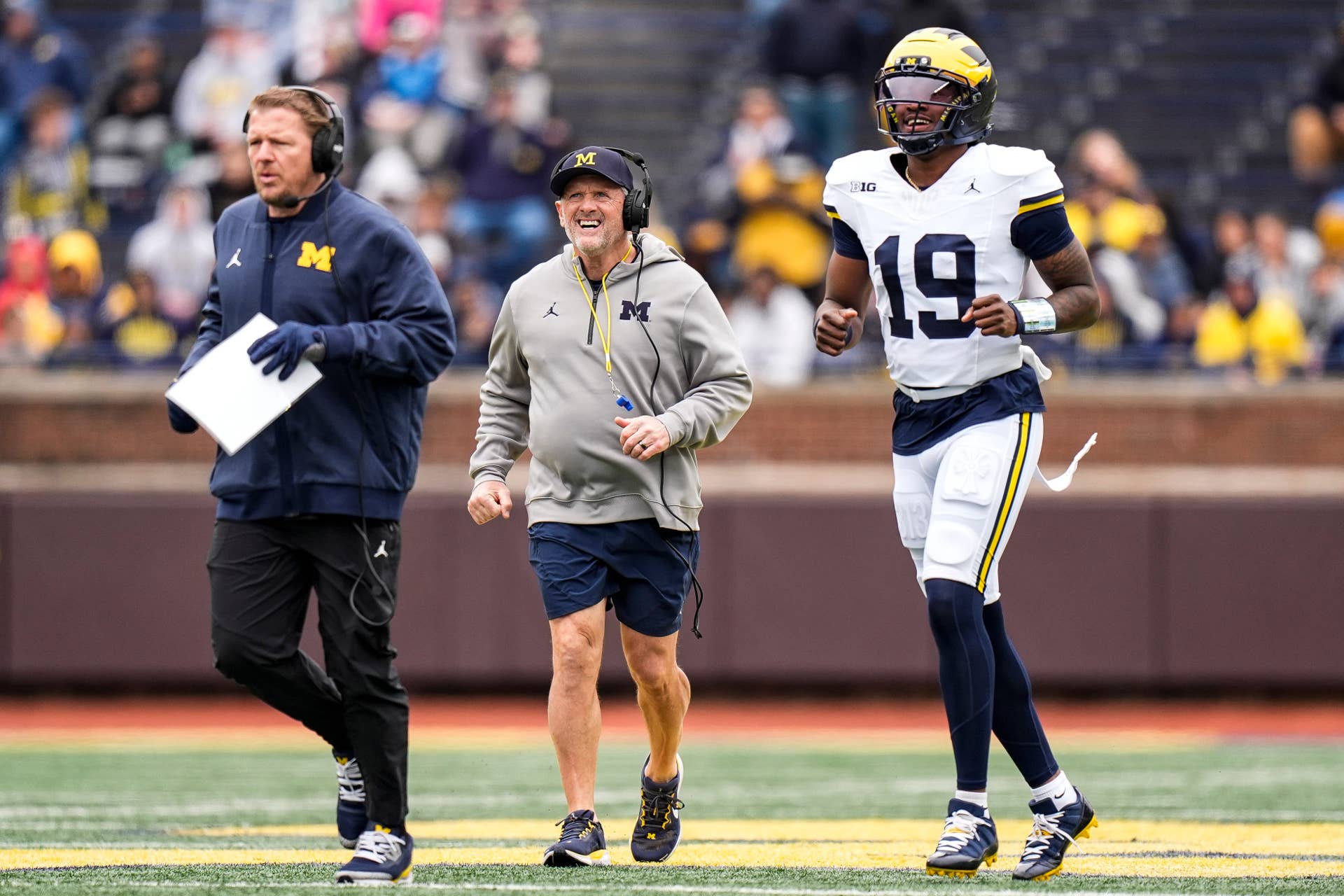
Michigan’s Bryce Underwood Has Failed to Live Up to the Hype
All offseason, questions swirled around the development, or lack thereof, of the Wolverines’ high-priced quarterback. In two games against quality competition, those questions have not been answered.
Underwood had a strong game a week ago against UTEP, finishing 19-of-25 for 223 yards and two touchdowns. But in the previous two games against Western Michigan and Oklahoma, two teams with quality defenses, Underwood had a difficult time completing passes and pushing the ball down the field.
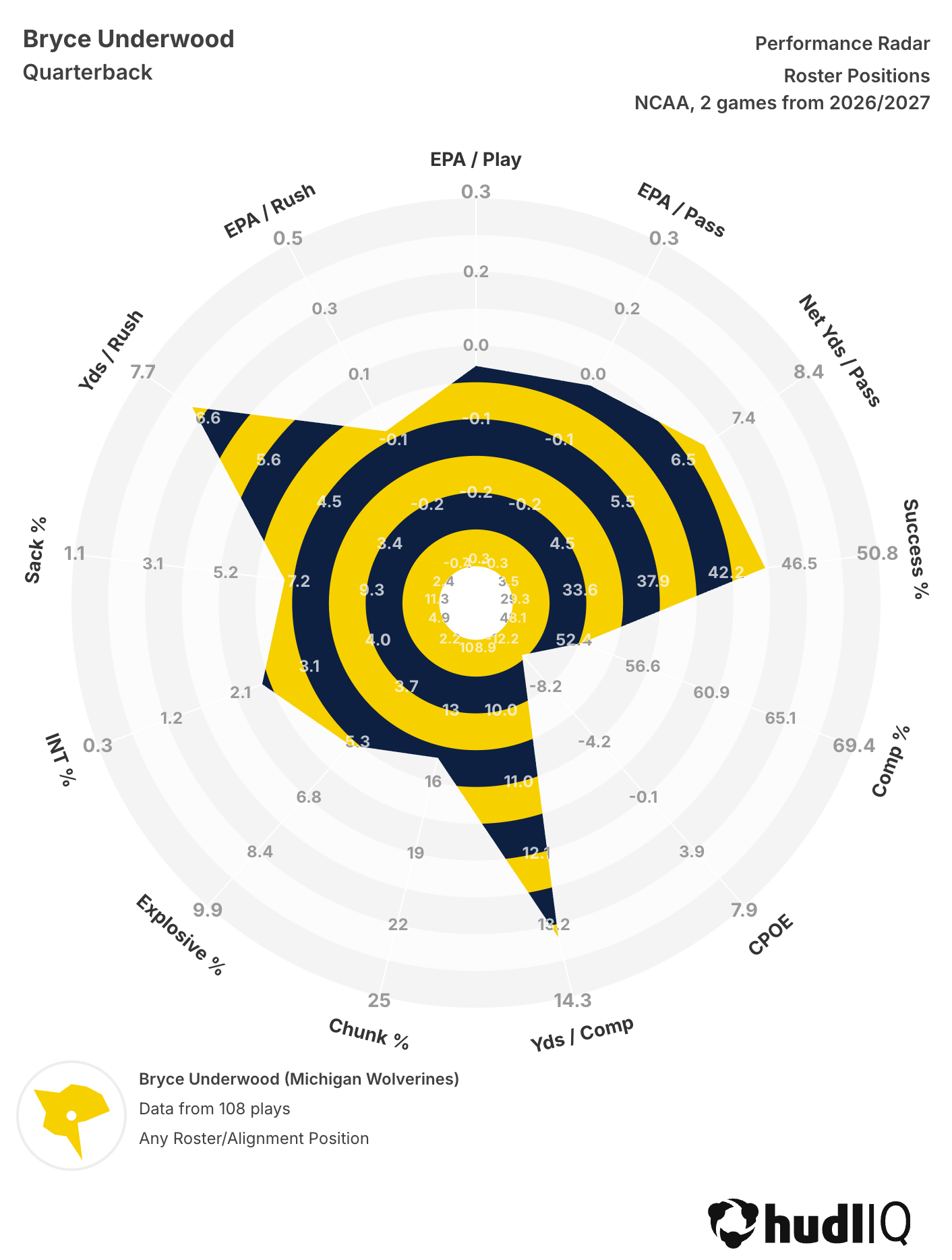
In Michigan’s first two games, Underwood finished with 0.01 EPA/play and 0.02 EPA/pass figures, per Hudl IQ. He was successful on fewer than 45% of his pass attempts (44.2 pass success percentage) and, on passes he did complete, he only pushed the ball downfield 6.7 net yards per pass, per Hudl IQ.
Perhaps the most damning stat of all is Underwood’s completion percentage over expectation (CPOE) of -10.4%, which is an indicator of how often he completes passes given the difficulty of his throws.
Despite all the discouraging statistical data around Underwood, there might be reason for optimism that he can turn things around.
He had a strong outing against UTEP, and he’s learning a new offense and working with a new offensive coordinator in former BYU playcaller Jason Beck. Beck is renowned for his ability to get good usage out of mobile quarterbacks, and Underwood certainly falls within that bucket.
If Beck can continue to utilize Underwood’s running abilities, as he did in a big spot against Oklahoma in Week 2, perhaps some of Underwood’s deficiencies as a passer will be offset.
Overall, Underwood simultaneously needs more reps and time to develop as a passer, and while getting those things down, he desperately needs to improve his accuracy and push the ball downfield when possible.
If he can learn to use his legs and push the ball downfield with more venom, Michigan could be a College Football Playoff-caliber team given how good the defense is playing. If not, the Wolverines might continue to be a tough offensive watch, and the questions around Underwood will only grow louder as the season progresses.
Texas A&M’s Marcel Reed is Struggling with Accuracy Woes
A season ago, Reed flashed some of his top-end abilities and helped push the Aggies into the 2025 College Football Playoff.
He’s always been a quarterback who plays on a knife’s edge, with plenty of good and bad games on his resume. A season ago, Reed was a positive influence on the Aggies’ offense and, by most advanced data, he was an above-league-average quarterback in the SEC.
Last season, Reed finished the campaign with positive EPA/play (0.15) and EPA/pass (0.10) figures, while completing 61.6% of his passes, per Hudl IQ. He finished with 8 net yards per pass, 13.5 yards per completion and generated chunk pass plays 20.3% of the time, per Hudl IQ.
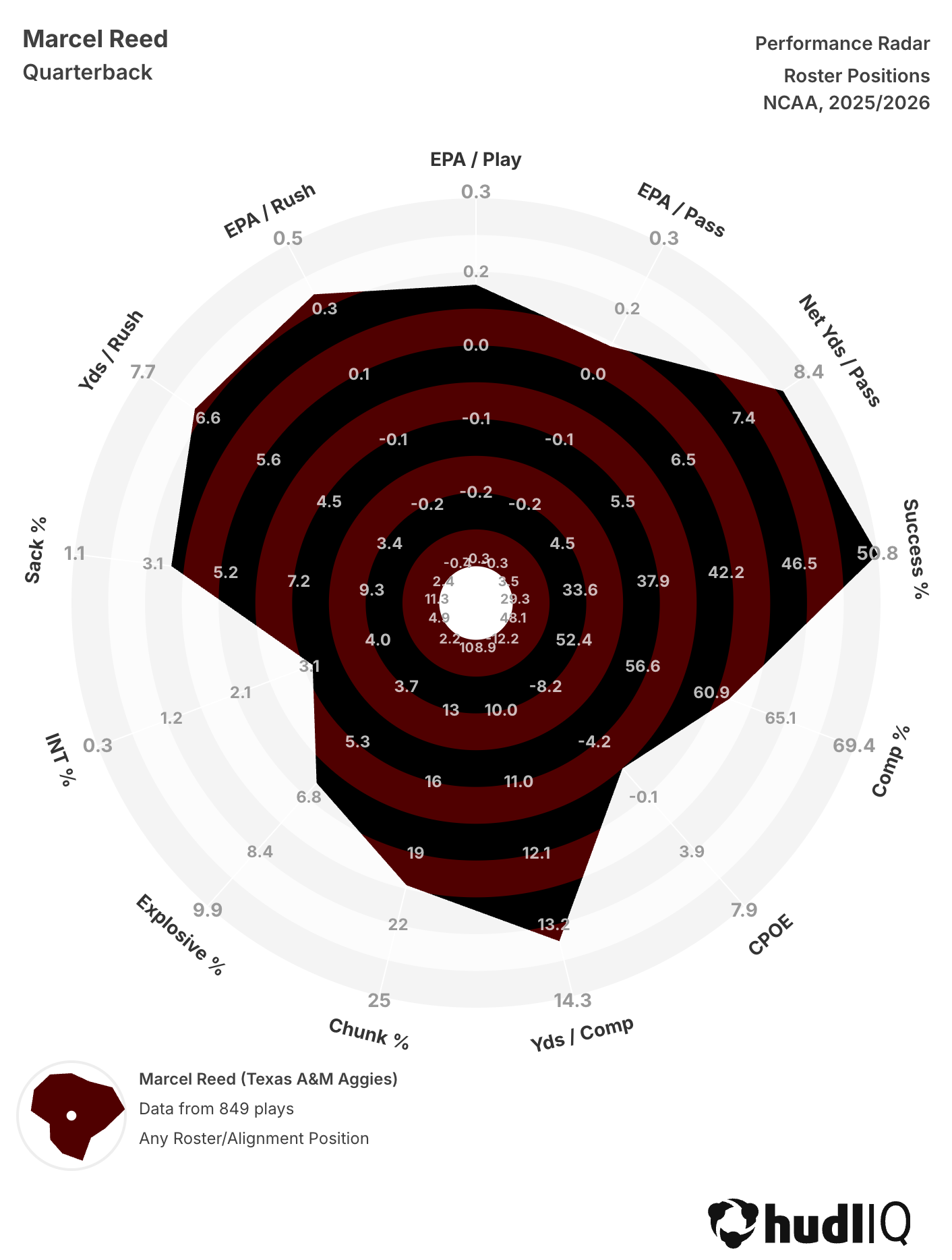
This season, however, all of those numbers have dipped, putting him below league average across most advanced statistics.
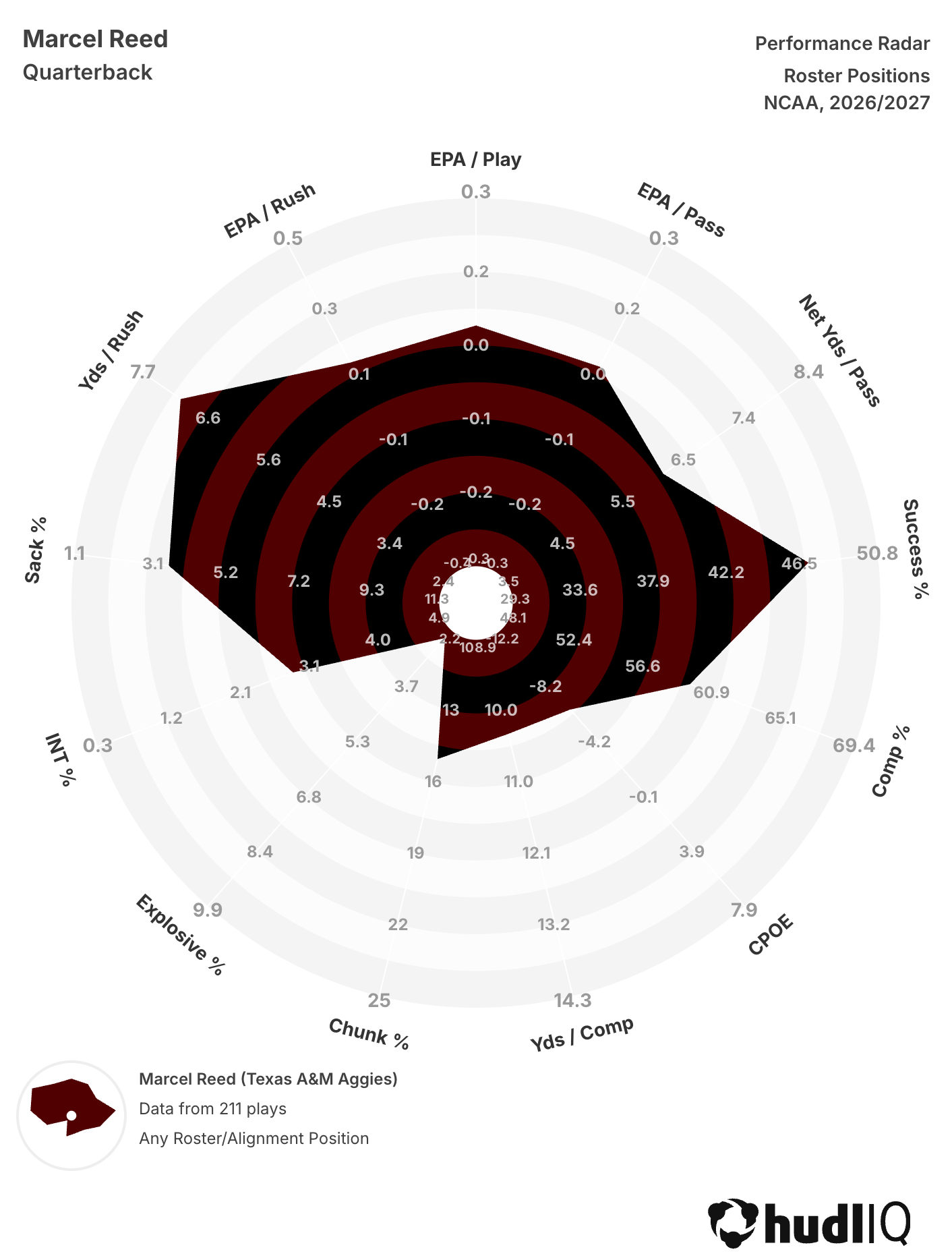
Through three games, Reed’s EPA/play has dipped from 0.15 to 0.08, and his EPA/pass has dropped from 0.10 to 0.06, per Hudl IQ. He’s also completed fewer than 60% of his passes (59.2%) and is generating chunk pass plays (15.1%) to a far lesser degree than he was a season ago, per Hudl IQ.
- 2026 College Football Panic Meter: 5 Playoff Contenders in Trouble After Week 3
Perhaps the most glaring year-to-year deficiency in Reed’s game is how often he completes passes given the difficulty of his throws. Last season, Reed notched a -2.1% completion percentage over expectation (CPOE) figure, a bad number by Power 4 quarterback standards.
But this season, he’s regressed to an even greater degree, notching an extremely poor -6.4% CPOE.
Unfortunately for the Aggies, the team has also trended in a downward direction, highlighted by an upset loss to Kentucky last weekend.
Reed will likely never be an extremely accurate passer of the football. His strengths include using his legs to evade pressure and create explosive plays when structure breaks down. That’s his bread and butter.
This season, opposing defenses have done a nice job of keeping him contained in the pocket and have forced him to beat them with accuracy. He’s failed to do so in big spots and didn’t have particularly strong games against Arizona State or Kentucky.
The trajectory of Texas A&M’s season likely hinges on Reed’s ability to fix the accuracy woes. If he does improve, his big-play abilities can help them win SEC games. If he doesn’t fix the accuracy problems, the Aggies feel like a safe bet to miss out on the conference title game and the College Football Playoff.
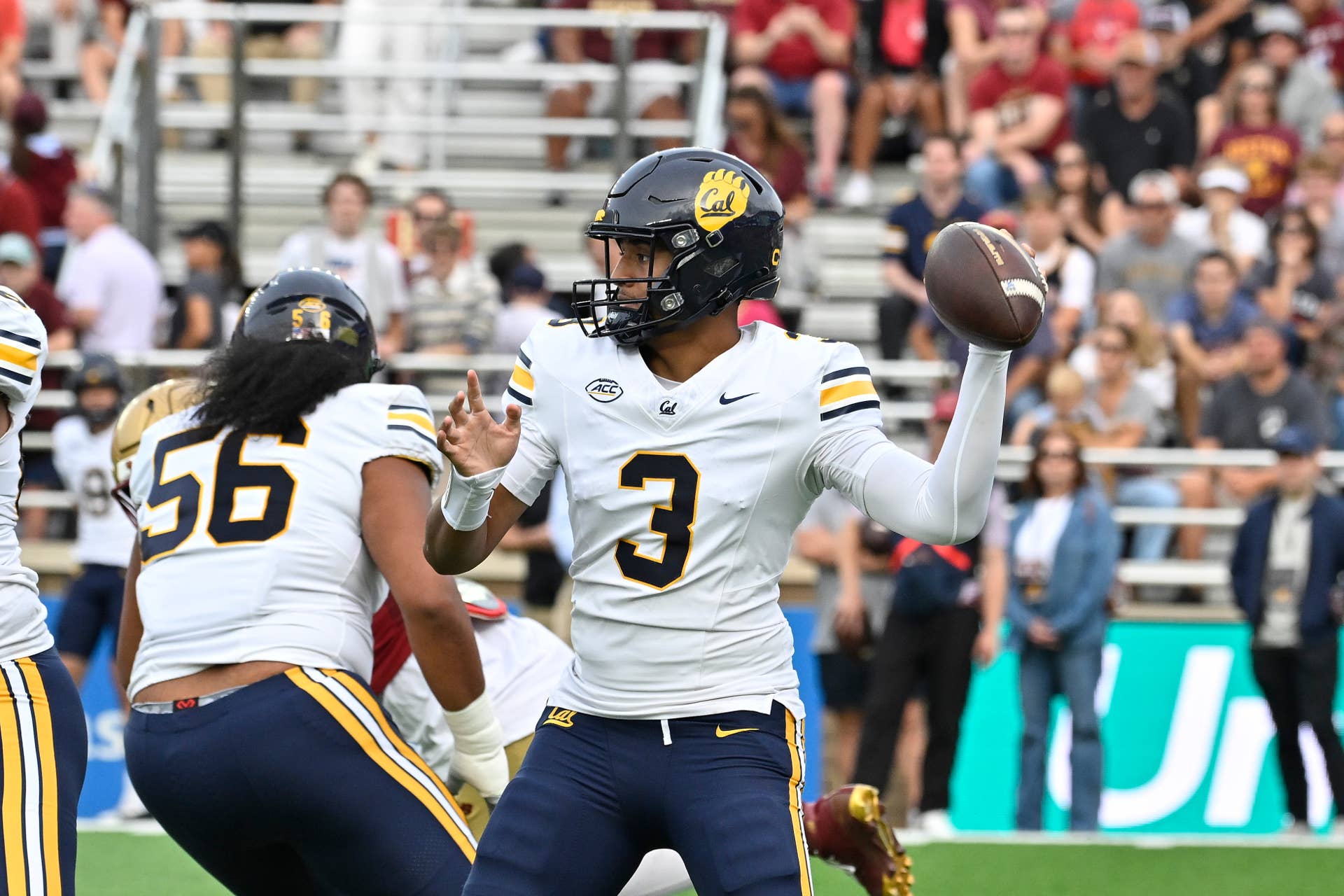
Cal’s Jaron-Keawe Sagapolutele Has Struggled Against Non-FCS Teams
A season ago, Sagapolutele was one of the best freshman quarterbacks in college football.
He wowed NFL scouts with his arm talent and impressed onlookers with his immense touch and accuracy. Entering this season, there was serious buzz around Sagapolutele, with many people bullish on the Golden Bears’ portal acquisitions aimed at getting the most of their young quarterback.
However, this season has not gone to plan.
Outside a dynamite performance against FCS Wagner, Sagapolutele has played like a below-league-average quarterback by some advanced metrics.
Through the Golden Bears’ first two games, Sagapolutele has posted a -0.15 EPA/play and -0.17 EPA/pass figures, per Hudl IQ. He’s averaging only 10.3 yards per completion and generating chunk pass plays on 13% of his completions, both below league average, per Hudl IQ.
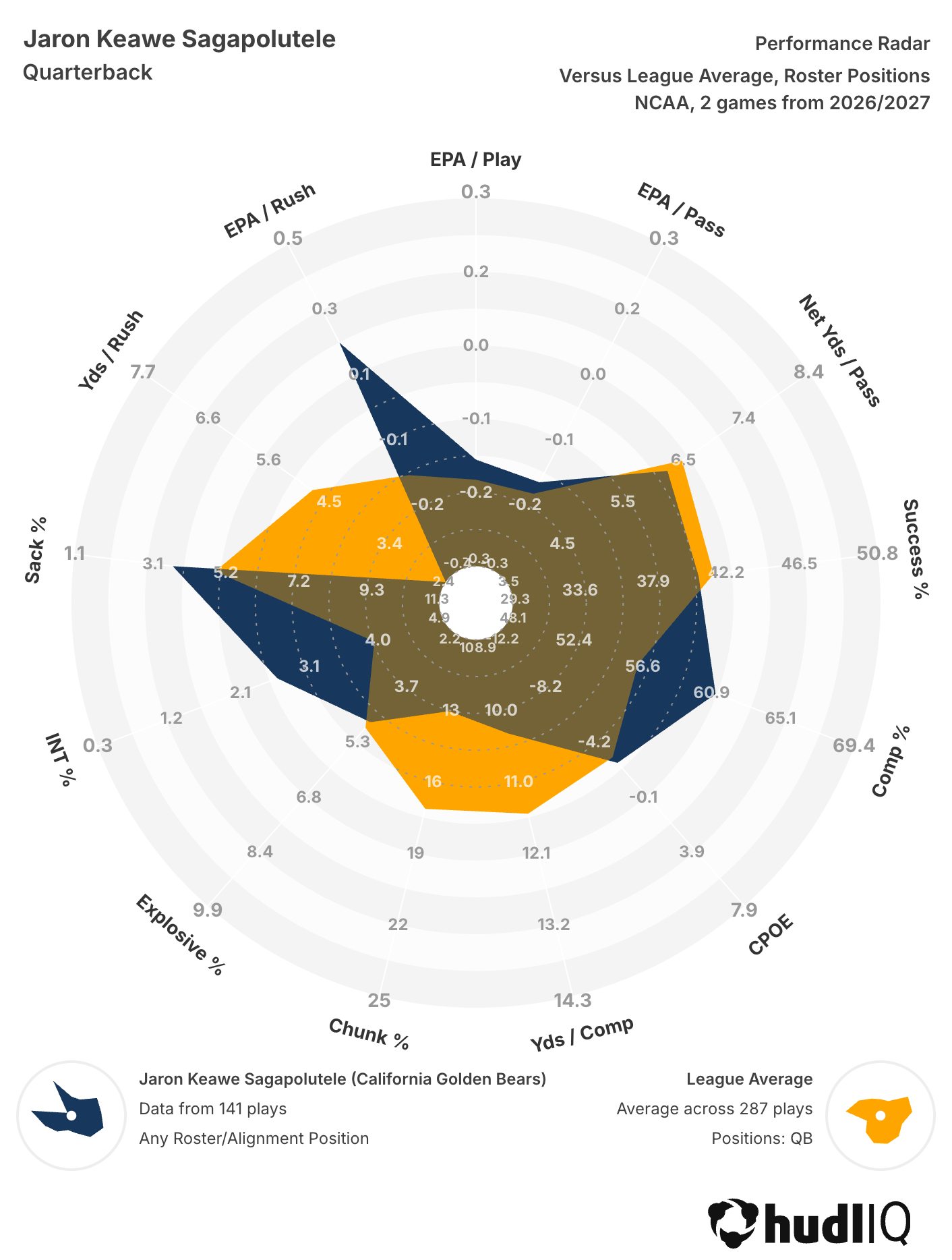
To those who watched Cal’s first two games, it often felt like the offense was too reliant on Sagapolutele to bail it out of difficult spots. The systen is clearly built around him, and while that’s not the problem, it can be problematic if he’s being asked to do too much on a regular basis.
The Cal offense could likely benefit from offensive coordinator Jordan Somerville doing a better job of scheming open receivers and encouraging Sagapolutele to get the ball out of his hands faster.
But unlike Underwood and Reed, Sagapolutele has flashed immense arm talent in more than a few games. There’s reason for optimism that with a better connection with his new receivers and perhaps some smarter game-planning, he can get back to playing more effective football.
With nine more regular season games to go, there’s still plenty of time for each of these players to improve and make positive strides. But with each of their respective programs embarking on conference play this weekend, the time is now for this group to step up their play if they hope to be the catalysts for positive momentum moving forward.


