


You spotted him a couple of weeks ago. Maybe it was a box score that looked wrong in a good way, or a podcast mention, or a start where the ERA was fine but the underlying numbers were better than fine. You wrote his name in a notebook. You didn't pull the trigger because you weren't sure.
Now he's in your news feed. A beat reporter is quoting him about how comfortable he's gotten with a new pitch. He sounds confident. Your league-mates haven't noticed yet. You have maybe ‘til the end of the work day before someone else does.
Here's the problem: pitchers say encouraging things about new pitches all the time. Half those pitches don't survive June. The quote means nothing. What matters is two numbers on Baseball Savant, and it takes about three minutes to find them. And then in the fourth minute, you add the arm that will carry you through the summer with a new pitch mix that leaves hitters flummoxed.
The League Is Adding Pitches in Every Direction at Once
The rate at which MLB pitchers expand their arsenals has roughly doubled in four years. Pitchers in our dataset averaged 0.27 new pitch additions per pitcher in the 2021-22 offseason. By 2024-25, that number was 0.53. Half of all pitchers under 26 added at least one pitch last offseason. More than a third of veterans did too.
The conventional wisdom says pitchers are chasing horizontal movement, and that's partially right. It seems like the sweeper sprouted five years ago and its now a monstrous oak tree. But in reality sinkers and cutters are the two most consistently added pitches by net impact, year over year. But the faster-growing category isn't horizontal at all. Splitters, curveballs, and knuckle-curves, pitches that tumble and drop, grew at 2.76x since 2021-22. Faster than the horizontal group. Faster than anything.
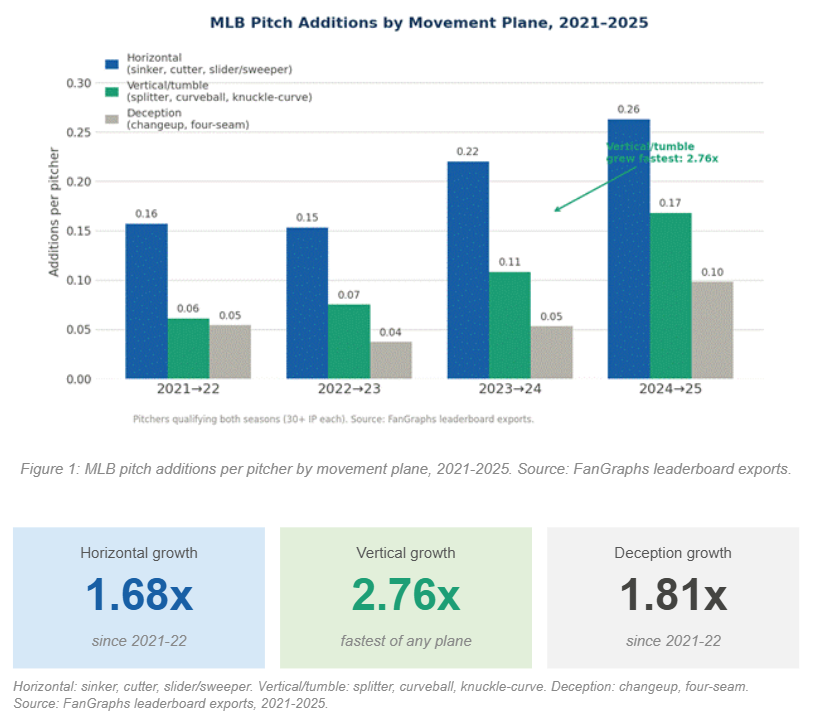
What the league is actually chasing isn't a direction. It's complexity. Every pitch a player adds to his repertoire forces the hitter to maintain a wider decision tree before the ball leaves their hand. Horizontal pitches are the most reliable tool for that, but a late-diving splitter does the same cognitive work from a different angle. The goal is to make the hitter commit late, and the league has figured out that more pitches, in more directions, is how you get there.
Which creates a problem for fantasy managers. When half the league is adding pitches every offseason, the notification that your guy has a new one isn't a signal. It's noise. The only thing that converts a beat reporter's quote into a roster decision is the two-step test.
Young Arms More Likely To Add To Repertoire
Young pitchers add at a slightly higher rate than veterans, but the gap has never been as wide as the fantasy community assumes. The ratio peaked at 1.39x in 2022-23 and is currently 1.24x.
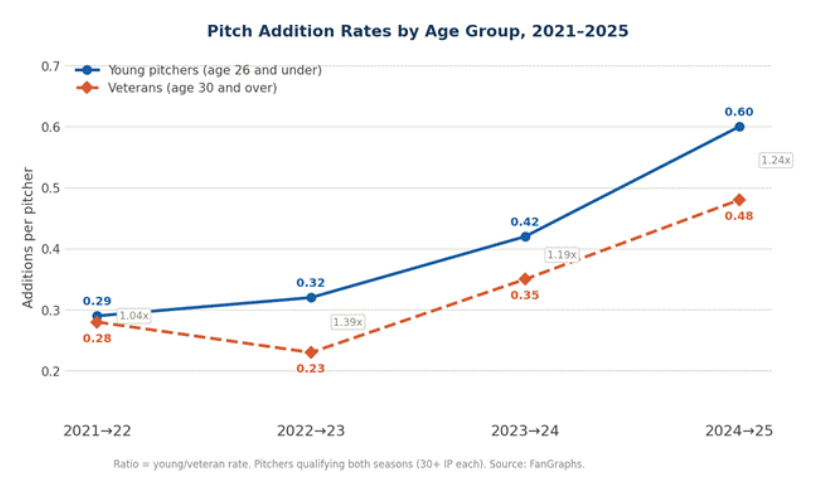
More importantly, both groups have accelerated dramatically together. Veterans went from 0.28 additions per pitcher in 2021-22 to 0.48 in 2024-25. Young pitchers went from 0.29 to 0.60. The story isn't young versus old. The story is that everyone is adding pitches at rates that would have been unrecognizable five years ago, which means age alone tells you almost nothing about whether an addition matters.
The Two-Step Test: Three Minutes, Two Clicks
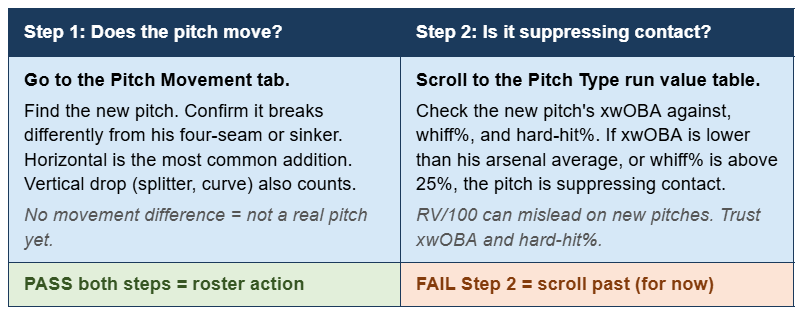
Both steps live on the pitcher's Baseball Savant page. Pull it up.
Three Pitchers. Three Outcomes.
Here's the test run on three real 2026 cases, each of which tells you something different about how to use it.

Brett Davis-Imagn Images
Bryce Elder, Atlanta Braves: The Clean Pass
Elder added a cutter. His ERA went from 5.30 to 2.66. His K/9 didn't move. That last part is the tell.
Step 1: The cutter breaks +1.0 inches glove-side (toward 1st base for a RHP) while his four-seam runs 2.5 inches arm-side (toward 3rd base for RHP). That's real horizontal separation. The pitch moves differently, in the opposite direction. Step 1 passes.
Step 2: Cutter run value +2.4. Hard-hit rate against the cutter dropped from 47.0% to 22.2%, a 24.8-point swing. xwOBA against is .296. Step 2 passes, emphatically.
The K/9 staying flat is not a flaw in the story, it is the story. Elder isn't missing bats with the cutter. He's getting weaker contact. The ERA drop happened entirely in the contact quality, which you would never find in the strikeout numbers. You would only find it by running this test.
Sandy Alcantara, Miami Marlins: The Surprise Pass
Alcantara told his pitching coach last year that he needed a pitch that breaks more and moves slower. The result is a sweeper he introduced this offseason. At first glance it looks like a standard pitch-addition story. It's more interesting than that.
Step 1: The sweeper breaks 11.7 inches glove-side. His slider, which existed before, now breaks 4.9 inches glove-side, up from 2.8 inches in 2025. These are two distinct pitches with 6.8 inches of horizontal separation between them. Adding the sweeper appears to have reshaped the slider in the process. Step 1 passes, for both new offerings simultaneously.
Step 2 is where it gets complicated. The sweeper's run value per 100 pitches is slightly negative at -0.6. If you stop there, you might scroll past. Don't. The sweeper's xwOBA against is .243 while the actual wOBA allowed is .300, meaning hitters are currently getting lucky against it. Whiff rate: 36.0%. Hard-hit rate: 16.7%, the lowest of any pitch in his arsenal. That run value is going to correct upward.
Meanwhile his sinker, which runs 17.7 inches arm-side and hasn't changed in two years, went from a hard-hit rate of 49.2% in 2025 to 39.2% in 2026. Same pitch, better results. That's what sequencing does. Hitters who used to sit on the sinker because it was the one dangerous pitch now have a sweeper and a reshaped slider to account for. The sinker didn't improve. The decision problem in front of the hitter got harder. Step 2 passes.
Jacob deGrom, Texas Rangers: The Instructive Fail

Jeff Curry-Imagn Images
deGrom brought back a sinker for the first time since 2019. Any time deGrom tries something new, you pay attention.
Step 1 passes easily: the sinker runs 8.5 inches arm-side against a four-seam that only runs 4.6 inches. Real movement, real separation.
Step 2 fails. Run value on the sinker: -2.5. Hitters are doing damage on it. His four-seam, still the backbone of the arsenal, carries a 47.6% hard-hit rate and a .357 xwOBA. The sinker has movement. It does not yet have contact suppression.
This is exactly what the test is designed to catch. Movement without contact suppression is a pitch that's being thrown, not a pitch that's winning. deGrom is deGrom and still absolutely worth rostering, but the sinker is not the reason. Check back in July. If the hard-hit rate on that pitch drops below 35% and the xwOBA approaches .300, the story changes.
Bookmark the Page. Run the Test.
Half the pitchers in this league added at least one pitch last offseason. That number is only going to grow. The push notification, the beat reporter's quote, the podcast mention, none of it tells you whether the addition is working. Two clicks on Baseball Savant does.
Elder passed. Alcantara passed, with a sweeper that's performing better than its raw run value suggests and a reshaped slider that came along for free. deGrom is a wait, which the test will tell you to revisit the moment his hard-hit rate moves.
You wrote the name in the notebook for a reason. Now you have a way to know if you were right.
Questions About Pitchers Adding Pitches, And What It All Means
What pitches are MLB pitchers adding most in 2026?
Sinker and cutter are the two most consistently added pitches by net impact. Splitters have grown fastest as a category, nearly quadrupling in net additions since 2021-22. The league is adding in every direction, not just horizontal.
Should I add a pitcher just because he added a new pitch?
No. Half of all pitchers added at least one pitch last offseason. The addition itself is baseline noise. What matters is whether the pitch passes a two-step test on Baseball Savant: confirmed movement profile, confirmed contact suppression via xwOBA and hard-hit rate.
How do I run the two-step test on Baseball Savant?
Pull up the pitcher's Savant page. Click the Pitch Movement tab and confirm the new pitch breaks differently from his fastball. Then scroll to the Pitch Type run value table and check the new pitch's xwOBA against and hard-hit rate. If xwOBA is below his arsenal average or whiff rate is above 25%, the pitch is suppressing contact.
Is Sandy Alcantara worth adding in fantasy baseball right now?
Yes, based on the two-step test. His sweeper breaks 11.7 inches glove-side with a 36% whiff rate and a 16.7% hard-hit rate, the lowest in his arsenal. A slightly negative RV/100 reflects hitter luck that xwOBA (.243) says will correct. His slider also gained 2.1 inches of horizontal break and went from a .349 xwOBA against in 2025 to .205 in 2026.
Is Jacob deGrom's new sinker a reason to add him?
Not yet. The sinker passes Step 1 with real movement, but its run value is -2.5 and hitters are doing damage on it. Step 2 fails. deGrom is worth rostering on his overall profile, but check back when the sinker's hard-hit rate drops and its xwOBA approaches league average.
What does hard-hit rate tell you about a new pitch?
Hard-hit rate measures the percentage of batted balls against a pitch that qualify as hard contact (exit velocity 95 mph or higher). On a new pitch, a hard-hit rate below 30% is a strong contact suppression signal. Above 40% means the pitch has movement but isn't fooling hitters yet.


