


[Editor’s note: The following article comes from Athlon Sports’ 2026 Golf Annual magazine. Order your copy online now, or pick one up at newsstands and retail racks nationwide.]
The calendar doesn’t lie. On Dec. 30, 2025, Eldrick Tont “Tiger” Woods turned 50. Half a century. For those of us who’ve spent our entire professional lives in golf, it’s a moment that demands reflection, not just on what Tiger has accomplished, but on how fundamentally he transformed the game we love.
I moved to Florida in August 1996, on the same day that Tiger held his “Hello World” press conference. I was unpacking boxes in my first apartment, watching this 20-year-old kid announce his arrival on the PGA Tour with a confidence that bordered on audacity. I had no idea I was witnessing the beginning of a revolution. None of us did.
Nearly three decades later, with Tiger having passed this milestone birthday, it’s worth examining not only the trophies and records, but also the seismic shifts he created in professional golf, in how we teach the game, and in who gets to play it.
JEFF HAYNES / AFP via Getty Images
The Prodigy Years: Building a Champion
Tiger’s story didn’t begin with that press conference, of course. It began in Cypress, California, where Earl Woods, a retired Army officer and Vietnam veteran, introduced his son to golf before the age of two. Earl had been a single-digit handicap amateur and one of the earliest African American college baseball players at Kansas State University. He understood competition, discipline and the power of setting audacious goals.
The young Tiger appeared on “The Mike Douglas Show” at age 3, putting against Bob Hope. At five, he was featured in Golf Digest. Before turning seven, he won the Under Age 10 section of the Drive, Pitch, and Putt competition. These weren’t just cute stories about a talented kid; they were early indicators of something unprecedented.
At age eight, Tiger won the Junior World Golf Championships in the youngest age group available. He would go on to win that event six times, including four consecutive victories from 1988 to 1991. At 15, he became the youngest U.S. Junior Amateur champion, a record that stood until 2010. He remains the only three-time winner of that championship.
His amateur career reads like fiction. Three consecutive U.S. Amateur titles. An NCAA individual golf championship. A silver medal as the leading amateur at The Open Championship. He was named Golf Digest Amateur Player of the Year and voted “Most Likely to Succeed” by his graduating class at Western High School.
Earl Woods had researched Jack Nicklaus’ records in detail and set his son the goal of breaking them.
The Professional Arrival: Rewriting the Playbook
When Tiger turned professional in August 1996, he immediately signed endorsement deals with Nike and Titleist that ranked as the most lucrative in golf history at that time. The expectations were enormous. He exceeded them.
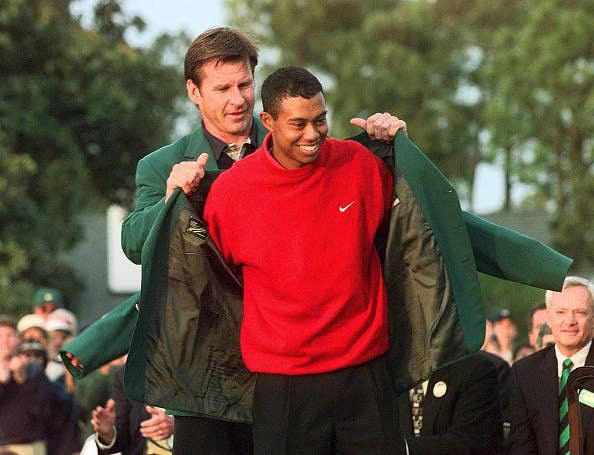
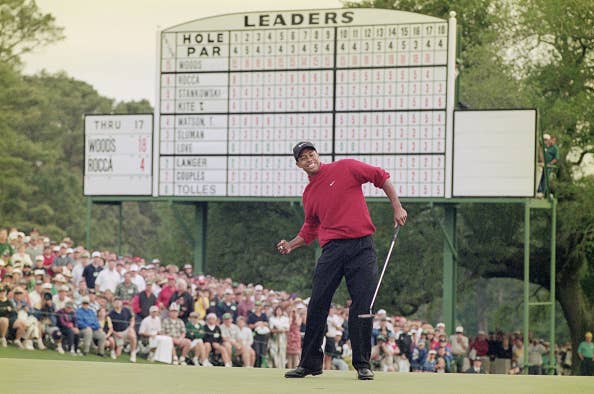
Within eight months, he won the 1997 Masters by 12 strokes in a record-breaking performance. He was 21. I watched that final round, jaw on the floor. This wasn’t just a talented young player winning a major; this was a complete dismantling of Augusta National and everything we thought we knew about the limits of golf performance.
By June 1997, less than a year after turning pro, Tiger reached No. 1 in the Official World Golf Ranking. He would hold that position for 683 total weeks, including a stretch of 281 consecutive weeks from June 2005 to October 2010.
The numbers tell part of the story: 82 PGA Tour wins (tied with Sam Snead for most all-time), 15 major championships (second only to Nicklaus’ 18), 18 World Golf Championship victories and countless other records. But numbers alone can’t capture what Tiger did for golf.
Stephen Munday/Allsport/Getty Images
The Tiger Effect: Transforming the Game
Before Tiger, professional golfers were athletes, sure, but they weren’t athletes in the way we understand the term today. Tiger changed that overnight. He brought serious strength training, conditioning and athletic preparation to a sport that had historically been more about skill and touch than power and explosiveness.
I’ve been a PGA professional and coach for 17 years now, and I can tell you with certainty: Every player on tour today benefits from Tiger’s transformation of golf fitness. The prize money increased dramatically during his peak years. Television ratings spiked whenever he played. Sponsors paid more. The entire economic ecosystem of professional golf expanded because of one man’s dominance and marketability.
But Tiger’s impact went beyond economics. He brought golf to people who had never seen themselves in it. Kids from backgrounds that country clubs had historically ignored picked up clubs because of Tiger. That shift was real and lasting. The game grew beyond its traditional borders because one man made it look different.
His influence on course design became its own phenomenon. Many courses in the PGA Tour rotation, including major championship sites like Augusta National, added yardage to their tees in an effort to reduce the advantage of long hitters like Woods, in a strategy that became known as “Tiger-proofing.” Woods welcomed the change, noting that adding yardage didn’t affect his ability to win.
Personal Struggles: A Human Story
No honest assessment of Tiger’s 50 years can ignore the personal challenges that became public in late 2009. The car crash near his Florida home. The revelations of infidelity. The dissolution of his marriage to Elin Nordegren. The loss of major endorsement deals.
These aren’t details to dwell on, but they’re part of the story. Tiger admitted his transgressions publicly, took time away from golf and worked to rebuild his life. He’s spoken about losing track of the Buddhist principles he was raised with, about feeling entitled, about making terrible choices.
What matters now, from the perspective of someone who has watched his entire career, is how he responded. He didn’t quit. He didn’t hide. He worked through it, acknowledged his failures and eventually returned to competition. That resilience, that refusal to let mistakes define him permanently, may be as instructive as any golf shot he ever hit.
The 2017 DUI arrest in Florida, where he was found asleep in his car due to a reaction to prescription medications, was another low point. He pleaded guilty to reckless driving, completed probation and again worked to move forward. These moments humanized someone who had seemed superhuman on the golf course.
Adam Cairns-USA TODAY Network
The Body Breaks Down: A Litany of Injuries
If there’s a tragedy in Tiger’s story, it’s not the personal struggles; it’s what his body endured and how it limited what should have been an even more dominant career.
The knee problems started early. In 2002, he had surgery to remove fluid and a benign tumor from his left knee. By 2008, he won the U.S. Open at Torrey Pines on what was essentially a broken leg (a torn ACL and double stress fracture in his left tibia). Days after that victory, he announced he would miss the remainder of the season for reconstructive surgery.
That U.S. Open victory might be the most remarkable achievement in golf history. Ninety-one holes of championship golf on a broken leg, culminating in a playoff victory over Rocco Mediate. Kenny Perry said afterward, “He beat everybody on one leg.” Tiger called it “my greatest-ever championship.”
But the back problems were worse. Much worse. Between 2014 and 2017, Tiger underwent four back surgeries, including a spinal fusion in April 2017 that most experts believed would end his competitive career. Before that procedure, Woods described himself as barely able to walk or play with his children.
The medical file is staggering: seven back surgeries, five knee surgeries, two Achilles procedures, emergency surgery following the near-fatal car accident in February 2021, plantar fasciitis surgery, ankle fusion and various other treatments. No golfer has absorbed this much physical damage and continued playing at an elite level.
The 2021 car crash in Rancho Palos Verdes, California, nearly cost him his leg. Comminuted open fractures of his right tibia and fibula, injuries to foot and ankle bones, as well as trauma requiring surgical release to relieve pressure from swelling. Medical experts questioned whether he’d walk normally again.
Fourteen months later, he competed at the 2022 Masters. I was there that week. Watching him navigate those hills, seeing him grimace with each step yet refuse to quit, was perhaps more impressive than his 2019 victory. Every step was a battle. Every swing required adjustments to compensate for his limitations. But he finished all four rounds.
The Impossible Comeback: 2019 Masters
Speaking of that 2019 Masters victory, it deserves its own section. After spinal fusion surgery, after years of struggle, after falling out of the top 1,000 golfers in the world, Tiger Woods won his 15th major championship at age 43.
I was at Augusta that Sunday. Standing on the grounds as Tiger made his way up the 18th fairway, the roar was unlike anything I’d experienced in nearly 30 years around this game. It wasn’t just about golf. It was about human determination, about refusing to accept that the story was over.
He finished 13-under par to win by one stroke over Dustin Johnson, Xander Schauffele and Brooks Koepka. At 43, he became the second-oldest golfer ever to win the Masters, after Jack Nicklaus, who was 46 when he triumphed in 1986.
The victory transcended sport. It was a testament to what humans can endure and overcome. Given the severity of his injuries and surgeries, given the spinal fusion that should have ended his career, Tiger’s 2019 Masters win stands as one of history’s greatest athletic achievements.
GREG LOVETT/PALM BEACH POST / USA TODAY NETWORK via Imagn Images
Beyond the Ropes: The TGR Foundation
While Tiger’s on-course accomplishments dominate headlines, his charitable work through the TGR Foundation represents a different kind of legacy, one that may ultimately prove more lasting.
The foundation was established in 1996 by Tiger and his father, Earl, with the primary goal of promoting golf among inner-city children. After 9/11, the foundation pivoted hard, transforming from a golf charity into a STEAM education powerhouse focused on Science, Technology, Engineering, Arts and Math.
Today, there are three TGR Learning Labs (in Anaheim, Philadelphia, and Los Angeles). These aren’t just buildings with computers. They’re idea factories where kids who might never have thought of themselves as “science people” get their hands on 3D printers and coding tools and suddenly discover talents they never knew they had.
The numbers tell a real story. The Earl Woods Scholar Program, named for Tiger’s father who passed in 2006, boasts a 98.7% college graduation rate for its scholars, miles above national averages. Since it started, the foundation has raised about $150 million and reached nearly 200,000 students.
In February 2025, kids from four local high schools gathered at the Anaheim Learning Lab to share ideas they’d developed for actual healthcare problems. The winning team from Western High created a home-care solution that helps patients connect with doctors outside traditional settings. Kids from neighborhoods that society often overlooks are building solutions for tomorrow’s problems. There are doctors, engineers and entrepreneurs out there who found their calling at a TGR Learning Lab.
Building Courses: TGR Design
In November 2006, Woods announced his intention to begin designing golf courses through TGR Design. The vision was ambitious: create courses that would challenge the best players while remaining accessible and enjoyable for average golfers.
The reality has been more complicated. Projects in Dubai, North Carolina and Mexico have faced delays and financial challenges — and in some cases, have been shelved indefinitely. The Al Ruwaya Golf Course in Dubai, initially expected to finish in 2009, saw only seven holes completed before the project was permanently shelved in 2011.
But Tiger’s influence on course design extends beyond his own company. His impact on how courses are designed, particularly for professional tournaments, has been profound. The “Tiger-proofing” phenomenon changed how architects think about championship venues, emphasizing length, strategic complexity and the premium on all-around excellence.
Greg Lovett / USA TODAY NETWORK via Imagn Images
The Future of Golf: TGL and PopStroke
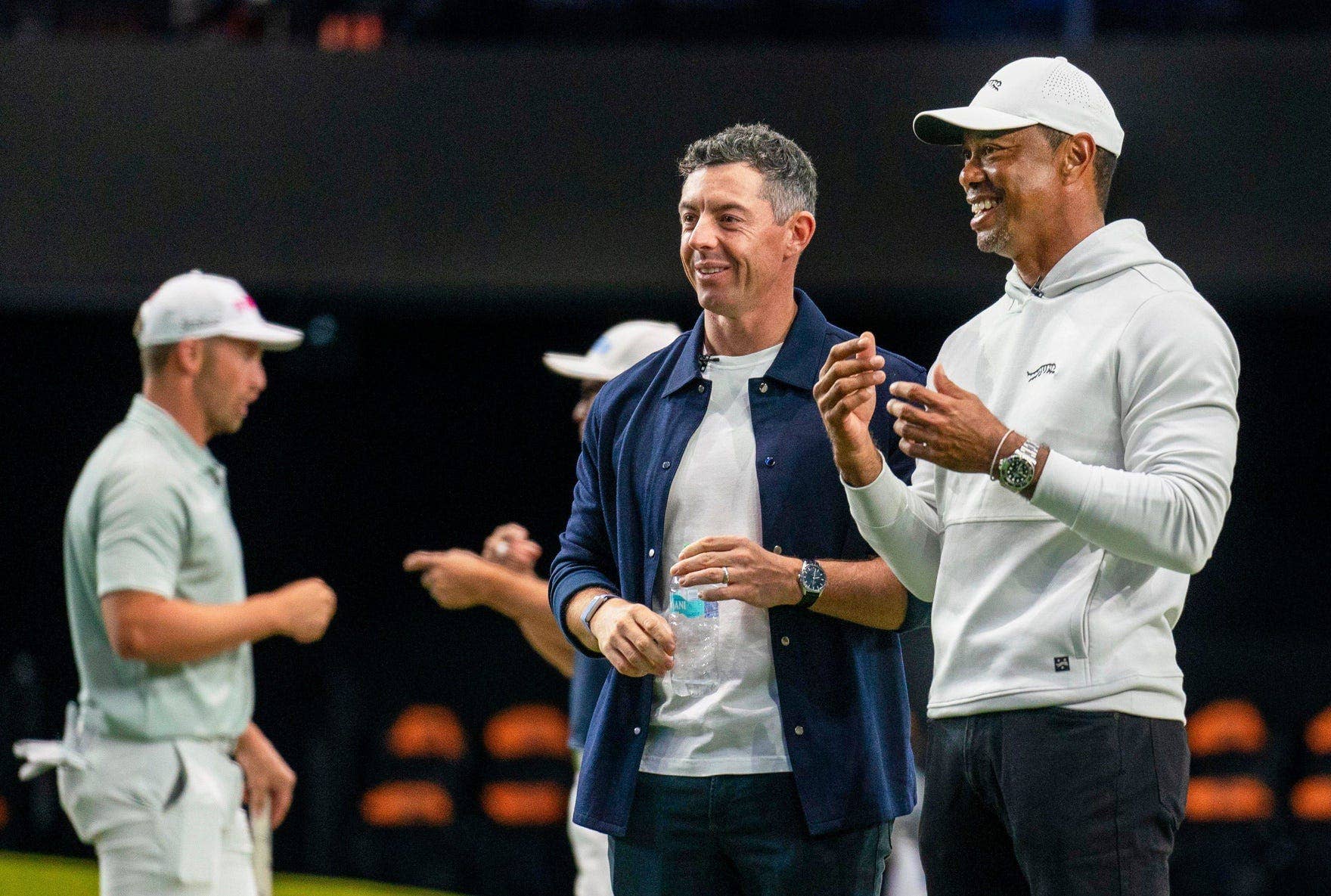
Tiger’s vision for golf’s future extends beyond traditional formats. In August 2022, Woods, Rory McIlroy, Mike McCarley and the PGA Tour announced the formation of TGL, a six-team virtual golfing league that combines technology with competition in a made-for-television format.
In November 2023, Woods revealed himself as co-owner and player for Jupiter Links Golf Club, one of the TGL teams. The league represents an attempt to bring golf to new audiences, particularly younger viewers who consume sports differently.
PopStroke, another Woods venture, takes a different approach to growing the game. These upscale putting course facilities combine competitive putting with food, drinks and entertainment, making golf more accessible and social. It’s a way to introduce people to the game without the barriers of traditional country clubs.
What Comes Next: Tiger at 50 and Beyond
So what does the future hold for Tiger Woods as he enters his sixth decade?
The most likely scenario is limited competition and a gradual transition. His October 2025 lumbar disc replacement surgery (his seventh back surgery overall) provides meaningful relief but not perfection. His Achilles has healed adequately, though some deficit remains. The fused ankle from the 2021 accident remains his biggest limitation.
Tiger will likely return to golf in 2026 or 2027 on an extremely limited schedule, perhaps four to six events per year. The majors will be priorities. Maybe the Genesis Invitational for his foundation. Perhaps the Hero World Challenge. He won’t contend regularly. Most weeks, he’ll make the cut but finish in the middle of the pack. But occasionally, everything will click, and he’ll find himself on the first page of the leaderboard on Sunday.
He probably won’t win another major. Limited playing time, reduced physical capabilities and the depth of modern talent make it too difficult. But he’ll have moments, flashes that remind us why we loved watching him.
Tiger will never officially retire. There will be no press conference, no farewell tour. He’ll just play less frequently until eventually, he doesn’t play at all. His last competitive round will happen without fanfare, and we won’t realize it was his last until months later.
But his transition into other roles is already underway. His course design business continues to evolve. He’s deeply involved with the PGA Tour’s direction. His foundation grows. He mentors young players. TGL and other ventures expand his influence beyond traditional competition.
GREG LOVETT / PALM BEACH POST / USA TODAY NETWORK via Imagn Images
The Unfinished Debate: Greatest Ever?
As Tiger turns 50, the debate about his place in golf history continues. He has 15 majors to Nicklaus’ 18. He’s tied with Sam Snead at 82 PGA Tour wins. He spent more weeks at No. 1 than anyone in history. He won in an era of unprecedented depth and global competition.
But the injuries robbed us of knowing what might have been. Without the knee surgeries, the back problems, the car accident: What would the record books show? Twenty majors? Twenty-five? Ninety PGA Tour wins? One hundred? We’ll never know. And maybe that’s okay. What Tiger accomplished, despite everything his body endured, is remarkable enough. Winning the 2008 U.S. Open on a broken leg and the 2019 Masters after spinal fusion. Playing the 2022 Masters after nearly losing his leg. These achievements transcend statistics.
The Real Legacy: Changing Who Gets to Play
If you ask me what Tiger’s most important contribution to golf has been, I won’t point to the majors or the money or even the athletic transformation of the sport. I’ll point to the kids who picked up clubs because they saw someone who looked like them dominating a game they’d never considered playing. Tiger made golf matter to people who didn’t care about golf. He became famous in a way golfers don’t usually become famous. He transcended the game, and in doing so, he opened doors that had been closed for generations.
The economic impact is measurable (prize purses increased, television ratings spiked, every player benefited financially from his presence). But the cultural impact is harder to quantify and ultimately more significant. Golf became more diverse, more accessible, more relevant because of Tiger Woods.
Fifty Years: A Life in Perspective
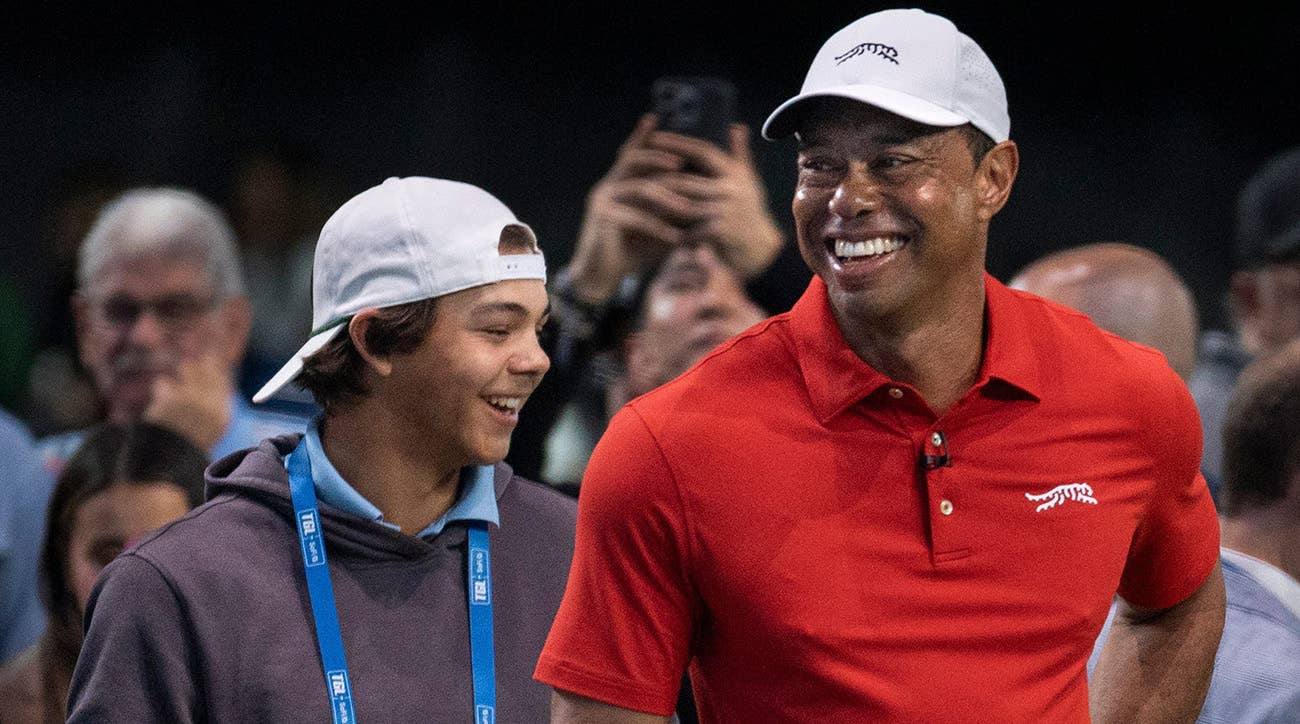
As Tiger turns 50, he’s no longer the young phenom who announced “Hello World” with supreme confidence. He’s a father of two, including a son, Charlie, who shows great promise as a golfer himself. He’s a businessman with ventures spanning course design, technology, entertainment and education. He’s a philanthropist whose foundation has touched nearly 200,000 students.
He’s also a man who has experienced extraordinary triumph and profound failure, who has pushed his body beyond reasonable limits, who has made terrible mistakes and worked to make amends, who has refused to quit when quitting would have been understandable.
For those of us who have spent our professional lives in golf, Tiger’s 50th birthday is a moment to reflect on how much the game has changed since that August day in 1996. The fitness standards are higher. The prize money is bigger. The global reach is wider. The diversity is greater. Not all of that is because of Tiger Woods, but much of it is.
There won’t ever be another Tiger. The combination of talent, timing, charisma and cultural impact that he represented was unique. We were fortunate to witness it, even with all its complications and contradictions.
Happy 50th birthday, Tiger. Thanks for changing everything.


