


In a piece published in early June, Athlon pointed out that Pete Crow-Armstrong’s increased production was simply a by-product of his on-field results finally catching up to his high-level contact quality. Crow-Armstrong has continued to mash the ball since that June 7th article and the early season trend that had his xwOBA outpacing his wOBA has since reversed. Fantasy managers still remember his sluggish first 58 games, when he hit just .224 with six home runs and a .676 OPS, and many are left asking: “will the real Crow-Armstrong please stand up?" Let’s try to figure out if Crow-Armstrong should be considered a hold or sell option for the second half of the season.
The Updated Data — What Three More Weeks of PCA Production Changed
Since those first forgettable 58 games Crow-Armstrong is batting .400, and he’s crushed 11 home runs in 27 games.
From xwOBA Leading wOBA to wOBA Leading xwOBA: The Gap That Flipped
Up until June 7, Crow-Armstrong’s xwOBA (.357) outpaced his wOBA (.344) by 13 points and he had a 120 wRC+.
Those stats signaled that Crow-Armstrong was a good buy low candidate who was poised for an uptick in offensive production. If you didn’t make a move to add him to your roster you are certainly regretting it because in his next 20 games from that date, Crow-Armstrong’s wOBA (.485) has outpaced his xwOBA (.371) by a whopping .114 points. He’s also posted a mammoth 215 wRC+ during that time span.
The Two Mechanical Improvements That Make the Hot Version More Real Than the Slump

Vincent Carchietta-Imagn Images
Crow-Armstrong’s has made improvements to his batting profile that, in theory, should help him avoid falling into future prolonged slumps.
Bat Speed, Lefty Split Reversal, and Why These Are Skill Changes Rather Than Sample Size Fluctuations
Crow-Armstrong’s overall average bat speed has risen to 74.8 mph this season, an increase of 2.1 mph since 2025. In addition, his fast-swing rate (percentage of swings that reaches at least 75 mph) increased from 28.5% in 2025 to 50.6% this season. As a reference point, league average bat speed is 72.1 mph and league average fast-swing rate is 26.3%. Higher bat speeds have been shown to be tied to an increase in slugging potential.
Crow-Armstrong has also adjusted his batting stance by lowering his hands and moving closer to the plate, changes that have significantly improved his production against both right- and left-handed pitching.
In 2025 Crow-Armstrong had a .271/.315/.523 triple slash vs. right-handed pitchers. He struggled against lefties to the tune of .188/.217/.376.
This season he’s slashing .280/.361/.537 vs. right-handed pitchers and .294/.395/.451 vs. southpaws. Of his 17 home runs, 13 have come against right-handed pitchers, but he’s evolved to the point that he’s no longer in danger of being platooned.
His increased walk rate was highlighted in Athlon’s previous Crow-Armstrong article and to his credit, his walk rate has improved even more since that article was published. Between June 8 and June 29 Crow-Armstrong has posted a 16.3% walk rate.
Hold, Sell, or Extend? The Full-Season Verdict and the Second-Half Decision
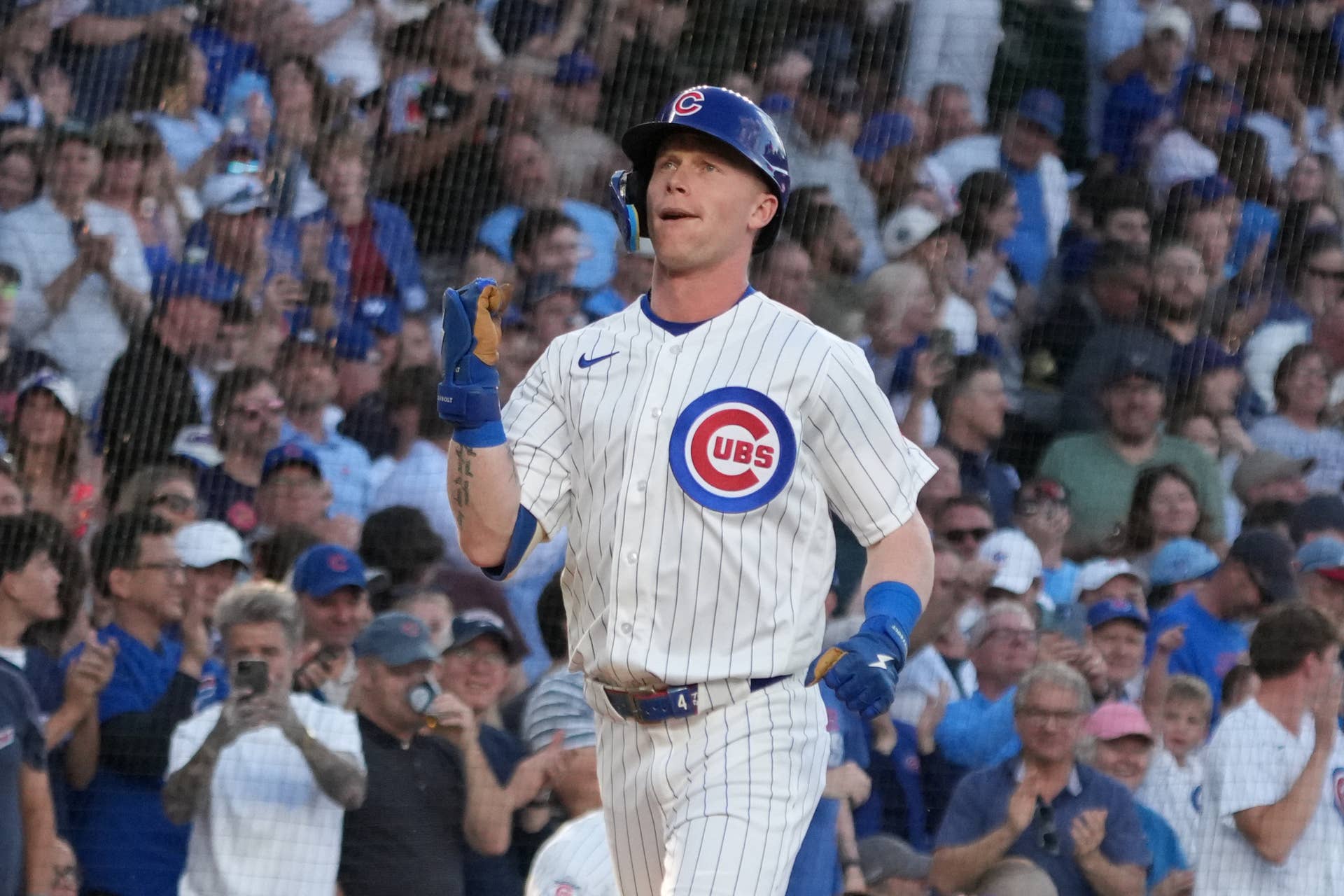
Mandatory Credit: David Banks-Imagn Images
Some fantasy baseball managers might have dropped Crow-Armstrong after his slow start and they’re regretting it now. Most signs point to his having a strong finish to the season but there is still a part of his profile that is slightly concerning.
The 30-30 Pace, the Mild Sell Signal, and the Specific Trade Scenario That Changes the Calculus
Crow-Armstrong has been a strong five-category contributor since late May and there’s a lot of red on his Statcast home page, which is a good thing. With 17 home runs and 20 stolen bases, Crow-Armstrong is well on his way to a second consecutive 30/30 season.
We’ve highlighted many of the advances he’s made in his batting profile in this article and the piece that was published in early June, however his chase rate and strikeout rate could be his kryptonite.
His chase rate is just under 5% less than last season, but at 36.9, it’s still way above league average. Crow-Armstrong’s overall K rate has slightly increased compared to last season and at 26% is also above the league average.
If those stats concern you, you can try trading Crow-Armstrong while his value is extremely high. He was recently traded straight up for Phillies ace Cristopher Sánchez in a yahoo! fantasy baseball league. Crow-Armstrong was also traded in a deal that brought back Julio Rodríguez and Munetaka Murakami.
Crow-Armstrong has both struggled and thrived this season and based on career statistics, his streakiness is nothing new. However, based on the improvements he’s made to his batting profile it’s very possible that his worst days are behind him.
Crow-Armstrong has been extremely hot over the last several weeks but based on his expected stats for that period and the rest of season predictions from just about all of the major projection models, his production is expected to level off. Those projection models still expect him to be fantasy relevant and predict that he’ll slug between 12 and 14 home runs and steal between 16 and 17 bases between now and the end of the season. That type of production can help you win a fantasy baseball title, but depending on your fantasy team’s depth, his current high trade value can help you fill any holes that you have on your fantasy team’s roster.
More Questions About Pete Crow-Armstrong, Answered
Is Pete Crow-Armstrong's 2026 production real or is it a hot streak?
Pete Crow-Armstrong's production appears to be supported by meaningful skill changes rather than simply a hot streak. His bat speed has increased, he has improved against both right- and left-handed pitching, and his walk rate has continued to climb. While his recent production is expected to cool somewhat, the underlying profile still supports continued fantasy value.
Should I sell Pete Crow-Armstrong in a fantasy baseball trade right now?
Holding remains a reasonable option because his underlying improvements support continued production, but selling can also make sense if another manager values him at his current peak. His trade value is extremely high, and depending on your roster construction, moving him for a premium return could address other needs.
What are Pete Crow-Armstrong's key improvements in 2026?
His biggest improvements include a 2.1 mph increase in average bat speed, a much higher fast-swing rate, improved production against left-handed pitching, and a stronger walk rate. Those changes suggest a more complete offensive profile than he showed during his early-season slump.
How much has Pete Crow-Armstrong improved against left-handed pitching in 2026?
Crow-Armstrong has made significant gains against left-handed pitching after struggling in that split last season. He is producing a much stronger slash line against southpaws, reducing concerns that he could lose playing time in platoon situations while making him a more complete fantasy contributor.
Is Pete Crow-Armstrong on pace for a 30/30 season in 2026?
Yes. With 17 home runs and 20 stolen bases, he remains on pace for another 30/30 campaign. Even if his recent production levels off somewhat, current projection models still forecast enough power and speed to make him a valuable fantasy contributor throughout the second half.
What does Pete Crow-Armstrong's recent performance mean for fantasy managers?
His recent surge has dramatically increased his fantasy value, but expectations should remain realistic. Projection models anticipate some regression from his hottest stretch while still forecasting meaningful home run and stolen base production. Managers should view him as a valuable asset whose current trade value may also create opportunities to improve other areas of a roster.


