


Sometimes we fantasy experts get ahead of ourselves. If we were writing a month ago about pitchers who improved from April to May, we would likely encourage you to acquire many of those names, on the assumption that the hurlers were on the rise.
We might even tell you to sell high if we don’t like what the underlying metrics say. We did that with Sonny Gray in late May.
Yeah … About Sonny Gray ...
I scanned 162 qualified starters through June. One pitcher improved both swinging-strike rate and K-BB% from April to May and then improved upon those May numbers through June. One pitcher. Sonny Gray. We will talk about Sonny Gray in a second. I will explain why our “sell” call reversed faster than expected, and I will explain why the pitch data is the part of this story that actually earns the hold recommendation. First, the methodology.
Why Single-Month Improvement Is a Watch, Not a Buy
A meaningful SwStr% gain from April to May generates a buy recommendation in about three quarters of fantasy outlets. The problem: 74 percent of pitchers who posted that gain in April-to-May gave at least some of it back in June. K-BB% gainers ran nearly identical. Three out of four pitchers who looked like they'd turned a corner in May were at least partially wrong about the corner.
What 'gave some of it back' actually means:
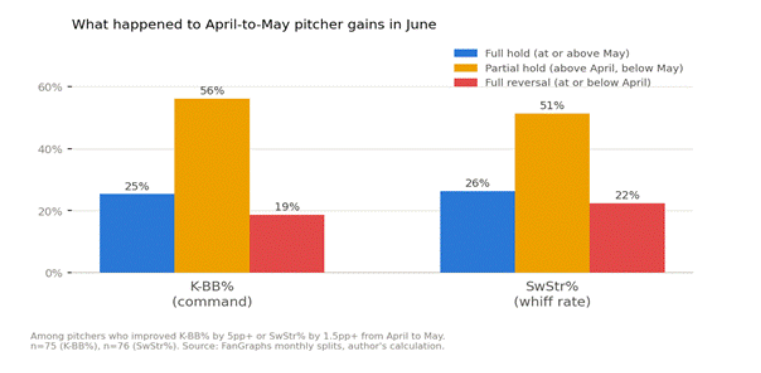
Source: FanGraphs monthly splits, author's calculation.
Most single-month gainers didn't collapse entirely. They landed between April and May, better than where they started, worse than where they peaked. The yellow bar is the story: 56 percent of K-BB% gainers and 51 percent of SwStr% gainers settled into a partial hold. That’s the definition of buying (or selling) high. You bought the May gains when the reality is regression was far more likely.
The filter that changes this: require improvement in both SwStr% and K-BB% in two consecutive months. A pitcher can lift whiff rate by expanding the zone, generating chases at the cost of walks. A pitcher can tighten command by throwing safer pitches at the cost of missing bats. When both metrics rise across two separate months, the likely explanation is a real underlying skill change, not a one-month tradeoff that will unwind itself in June. Among 162 qualified starters, that two-month filter produced exactly one name.
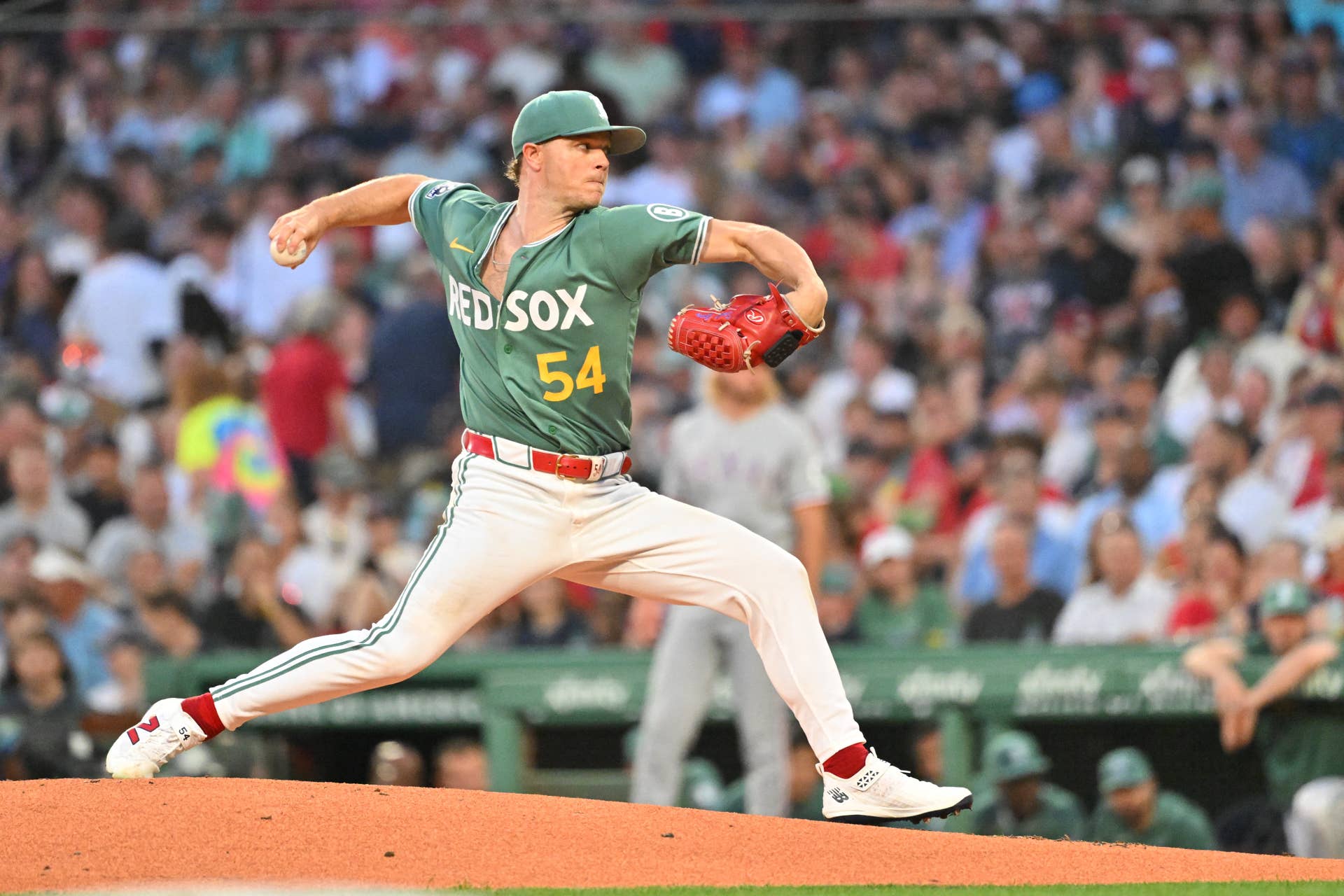
Sonny Gray and the May Sell Call That Resolved Early
Mandatory Credit: Bob DeChiara-Imagn Images
How the xERA Gap Closed, and What the Arsenal Data Actually Shows
In May, Gray’s ERA was 3.18. His xERA was 5.16. The gap was real, the underlying contact profile supported it, and the call was correct at the time.
What we didn't anticipate: the double-improvement in SwStr% and K-BB% that was already building kept going in June rather than following the 74 percent regression path. His xERA fell from 5.33 in April to 2.46 in June. His wOBA against is now .292 and his xwOBA against is .296, within four points of each other on Savant and both sitting in the 95th percentile. This is not a case of a pitcher getting lucky. This is a pitcher whose underlying contact quality is nearly elite.
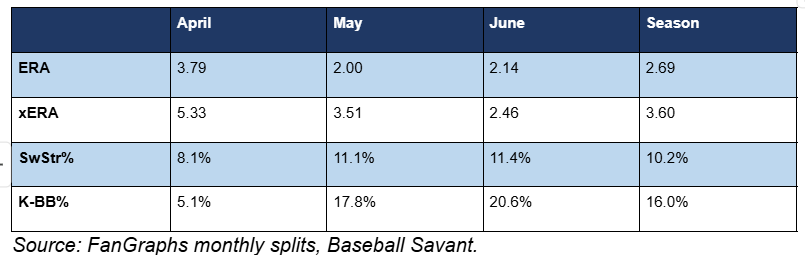
The mechanism is in the pitch data, and it is worth naming specifically because it is what separates Gray's held gains from the 74 percent who gave theirs back.
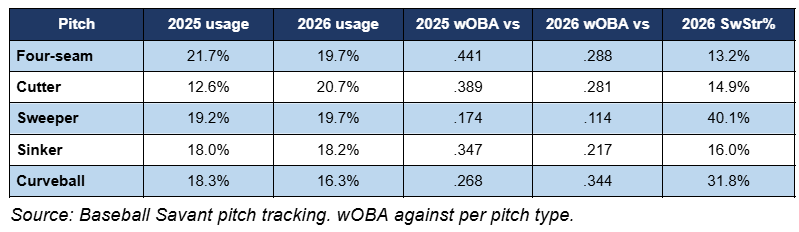
Two things happened between 2025 and 2026. First, the cutter went from an afterthought at 12.6 percent of pitches to his most-used pitch at 20.7 percent, and it went from a .389 wOBA against to .281. It is not just that he throws it more. The pitch itself is better. Second, the sweeper, already his best pitch in 2025, got even better: .174 wOBA against became .114, with a 40.1 percent swinging-strike rate. A pitch generating four outs of every ten swings is not a pitch hitters are figuring out.
What changed is that he built his 2026 arsenal around three pitches that all suppress contact from different directions: cutter glove-side, sinker arm-side with a 47.5 percent GB%, and sweeper as the primary swing-and-miss weapon. In 2025 his four-seamer was getting hit at a .441 wOBA against and eating into his numbers. This year it's down to .288 wOBA against, partly because hitters are now preparing for the cutter and sweeper first. The four-seam plays up because it arrives in a more hostile context. This is the sequencing argument, documented in the actual hit quality numbers.
His command history adds the second layer. Gray posted a 1.89 BB/9 in 2025 with St. Louis. The 2026 BB% of 6.2 percent ranks in the 83rd percentile. The command gains that showed up in May were a return to an established baseline, not a new development. The SwStr% improvement built on top of that foundation and held. Both things being true at once is precisely what the two-month filter is designed to detect.
One forward-looking note: Gray is a trade deadline candidate. The Red Sox are sellers. A move to a contending team adds win-support to a profile that already passes every underlying check. The trade is upside. Hold him regardless of destination.
The Three-Question Filter
Eric Canha-Imagn Images
Simply improving a key statistic or two month-over-month might be encouraging, but even us fantasy experts can get a bit carried away with increasing performance. But, remember, one month is a small sample size. When you can package multiple months together, then you are building real profiles. So we’ve built a 3-question cheat sheet to keep us honest and to keep you on the right track.
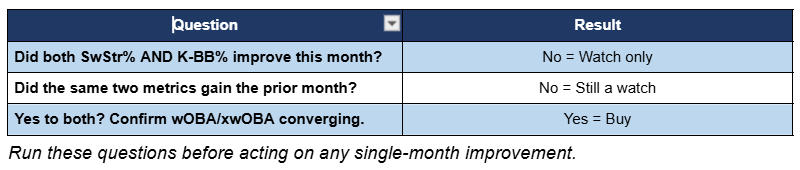
Run these questions before acting on any single-month improvement.
The July data will produce a fresh list of single-month improvers. Most will give some of it back in August. The one or two who hold both metrics through July are the next Sonny Gray. Through June, only one starting pitcher in baseball passed the full filter. His arsenal data explains why. You now know what to look for in the next one.
All figures from FanGraphs monthly splits and Baseball Savant through June 30, 2026.
Questions About Sonny Gray, Answered
What does it mean when a pitcher improves his SwStr% and K-BB% in the same month?
A single month of improvement in both swinging-strike rate and command is a watch signal, not a buy trigger, because 74 percent of pitchers who posted that combination from April to May gave at least some of it back in June. The buy trigger is two consecutive months of improvement in both metrics, a bar that only one of 162 qualified starters cleared through June 2026.
Is Sonny Gray a hold in fantasy baseball in 2026?
Yes. Gray is the only qualified starter in a scan of 162 pitchers who improved both SwStr% and K-BB% from April to May and held both gains through June, carrying a 2.69 ERA and 1.11 WHIP across 83.2 innings with a wOBA against of .292 and xwOBA of .296, both in the 95th percentile on Savant. A potential trade deadline move from Boston to a contender would add win-support to a profile that already clears every underlying bar.
Athlon called Sonny Gray a sell in May 2026. Why is he now a hold?
The May sell call was correct at the time: his xERA was 5.16 against a 3.18 ERA and the underlying contact profile didn't support the surface number. What changed is that his cutter usage jumped from 12.6 to 20.7 percent of pitches between 2025 and 2026 while its wOBA against dropped from .389 to .281, and his sweeper's wOBA against fell to .114 with a 40 percent swinging-strike rate, closing the xERA gap through genuine arsenal improvement rather than luck.
How do I know if a pitcher's improvement is real or just a hot month?
Run three questions: did he improve in both SwStr% and K-BB% this month, did he show the same improvement the month before, and is his wOBA against converging toward his xwOBA against on Savant. All three yes is a buy; anything short of that is a watch.
What is the two-month double-improvement filter for pitchers in fantasy baseball?
The filter requires meaningful gains in both swinging-strike rate and K-BB% across two consecutive months before treating any pitcher as a genuine buy target. One month of improvement in either metric has a 74 percent regression rate in the following month; two consecutive months of both metrics improving simultaneously is what the data says is actually durable.
Why did only one starter hold both whiff and command gains through June 2026?
Holding both metrics simultaneously across two months requires a genuine underlying skill change, not a favorable schedule or a one-month tradeoff, and for most pitchers those tradeoffs unwind themselves within 30 days. Sonny Gray is the exception because his gains were backed by a documented arsenal shift: his cutter and sweeper both improved in quality, not just usage, which is the kind of structural change that monthly noise can't explain away.


