


Lionel Messi is not a man who gets tattoos for the sake of it. Each of the Argentina captain's ink marks on his body is a story of his life, whether it's a nod to his family, a symbol of his faith, or a reminder of the path that led him to become one of soccer's all-time greats.
Messi's collection has expanded over the years as his career has progressed. His tattoos are a visual diary of the people and moments that have been significant to him, from his early days at Barcelona to his FIFA World Cup victory with Argentina.
Family and Faith Are at the Heart of Messi's Tattoos
Messi's first big tattoo was a picture of his mother, Celia, on his left shoulder. It's a tribute to the woman who was there for him throughout his childhood and encouraged him to pursue his dream of becoming a professional soccer player.
Antonela Roccuzzo, his wife, is also prominently featured in his tattoo collection. One of the most famous is an eye tattoo on his right arm, which is thought to be a tribute to Antonela, and a small lip tattoo on his lower lip, which is another tribute to their relationship. The couple also has matching crown tattoos, representing the king and queen of their family.
His three sons have inspired several of Messi's most personal tattoos. Thiago's little handprints are on his left calf, and the names of Thiago, Mateo, and Ciro are written above his ankle. Instead of celebrating trophies, Messi has always opted to pay tribute to those around him.
Another common theme is faith. He has a portrait of Jesus with a crown of thorns in his right arm, and religious art such as rosary beads and a rose-window design based on church architecture. The sleeve is finished with a pocket watch and clock gears, symbolizing the importance of time.
Why Messi's Left Leg Tattoo Is So Famous
Messi's left leg is now his most iconic tattoo. He chose to redesign some of the previous artwork, and much of the lower leg is now black ink, giving him the bold look that fans know today.
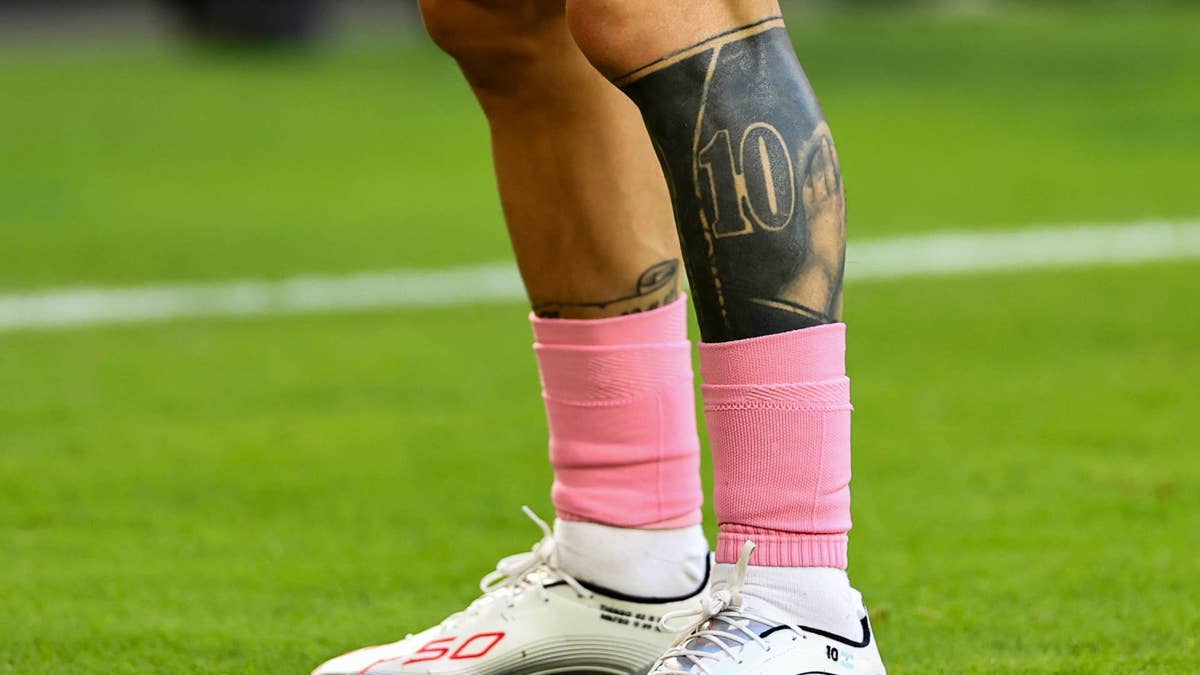
(Photo by Robbie Jay Barratt - AMA/Getty Images)
Although the blackout design, there are some important symbols that can be seen. A soccer ball, his iconic No. 10, Barcelona-inspired artwork, and Thiago's handprints all honor the game and the family that has defined his life.
Another detail that often catches fans' attention is the Five of Cups playing card. It has been associated with a card game that Messi played with Argentina teammates before one of the country's most successful periods, but he has never made it public.
Messi's tattoos are a story in themselves, and when combined, they tell a tale that extends beyond football.


