


Julio Rodriguez is like a 13-year-old. It’s Saturday, the whole family has been up for hours, ate breakfast, run out to the store and we’ve already streamed the first three episodes of “The Bear” before he even wakes up. It’s noon in our household and Julio Rodriguez is about to have a very productive afternoon.
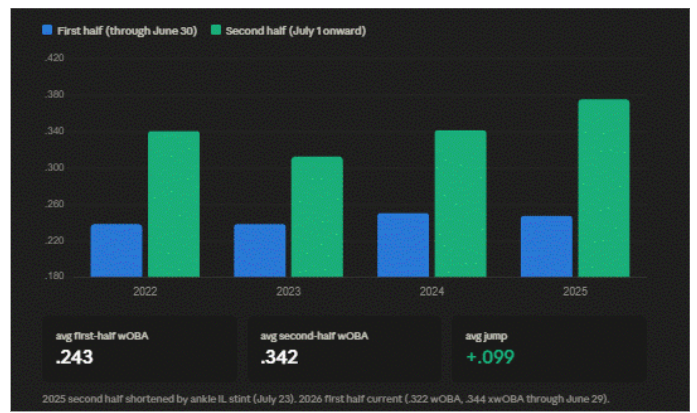
It’s an established pattern: Julio Rodriguez hits like a replacement-level outfielder for the first three months, then spends July through September hitting like a different person entirely. In 2023, his stat line through June 30 was .238/.294 with a .710 OPS. From July 1 through the end of the season, it was .312 with a .925 OPS. He was named AL Player of the Month for August. The same guy.
It is now the last week of June 2026. Rodriguez is batting .249 with a .745 OPS, nine stolen bases, and 14 home runs. His current owners are considering their options. Some of them have already moved on.
Those people are about to have a bad July, to say nothing of August and September.
The Surface Numbers Are Doing You Dirty
Jay Biggerstaff-Imagn Images
The box score on Julio Rodriguez in 2026 says: underwhelming. The Statcast page says something else. His average exit velocity is 90.1 mph. His hard-hit rate is 43.7 percent. His barrel rate is 9.3 percent. His expected weighted on-base average is .344, against an actual wOBA of .322.
That 22-point gap between what he is doing and what his results say is not a skill problem. Exit velocity does not lie about a hitter's underlying quality the way batting average does. Neither does hard-hit rate. When those numbers look like a top-15 outfielder's and the wOBA looks like a waiver wire candidate, the most probable explanation is that the batted balls are finding fielders at a higher rate than they should. That corrects. It always corrects.
The stolen base pace is worth flagging honestly: nine steals through 76 games projects to somewhere around 19 for the season. If you expected 25-plus steals, I’m not saying it can’t happen, I’m just doing the math. But the stolen base total is exactly the kind of number that tends to spike in August when Rodriguez is healthy, comfortable, and playing his best baseball. His career split is not subtle on this. He accelerates in the second half in every counting category.
The Pattern, And Why It Keeps Happening
Rodriguez's career first-half/second-half split is one of the more consistent data points in fantasy baseball. It is not a fluke. In 2023 he hit .238 through June and .312 from July on. In 2025 he hit .247 through June and .375 in July before an ankle injury ended the run. Every year, fantasy managers decide he has regressed. Every year, the second half reminds them he has not.
Part of this is mechanical: Rodriguez has historically needed more at-bats than most players to find his timing against the variety of stuff he sees early in a season. Part of it is luck-driven: BABIP in March through June tends to run below his career norms because of defensive positioning and early-season cold at-bats. The contact quality in those months is often just as good. The results just do not reflect it yet.
The Trade Decision Is Not Complicated

John Froschauer-Imagn Images
The manager offering you a deal for Rodriguez right now is pricing him at .249 and a .745 OPS. That is the only reason the offer exists. The question is not whether Rodriguez is underperforming his expectations. He is. The question is whether the underperformance is real or temporary. A .344 xwOBA from a 25-year-old center fielder on a first-place Mariners team says temporary.
If you own Rodriguez, do not sell into the current box score. The buy price for anybody else trying to acquire him should reflect the .344 xwOBA, not the .322 wOBA. An SP2-equivalent or a top-35 outfielder performing at face value is fair. Below that, you are doing the other manager a favor.
The one number to watch that tells you the regression has arrived: a 15-game stretch where his BABIP climbs back above .300 and stays there. When you see it, the contact quality and the results will finally be saying the same thing at the same time. That window historically opens in July.
It is the last week of June. You have watched this movie before. Let’s go make some popcorn and flip the calendar to July.
Questions About Julio Rodriguez, Answered
Is Julio Rodriguez a good fantasy baseball player in the second half?
Rodriguez has posted a .342 average wOBA in the second half across his first four MLB seasons, roughly 100 points higher than his first-half average every single year.
Should I sell Julio Rodriguez in fantasy baseball right now?
No. Rodriguez has never hit above .250 before July 1 and has never had a bad second half. Selling him in late June means selling at the exact wrong moment.
Why is Julio Rodriguez struggling in the first half of 2026?
His contact quality metrics — 90.1 mph exit velocity, 43.7 hard-hit rate, and .344 xwOBA -- are all well above average. The surface numbers are the anomaly, not the player.
What is Julio Rodriguez's xwOBA in 2026?
His xwOBA is .344 against a surface wOBA of .322, a 22-point gap driven by batted-ball luck rather than any change in his underlying contact quality.
Has Julio Rodriguez always been a slow starter?
Yes. He has hit below .250 in the first half in every season of his career and has responded with a .342 or better wOBA after July 1 each time.
Is Julio Rodriguez worth trading for right now?
Yes, if the asking price reflects his .322 surface wOBA rather than his .344 xwOBA and his documented history of second-half surges.


