


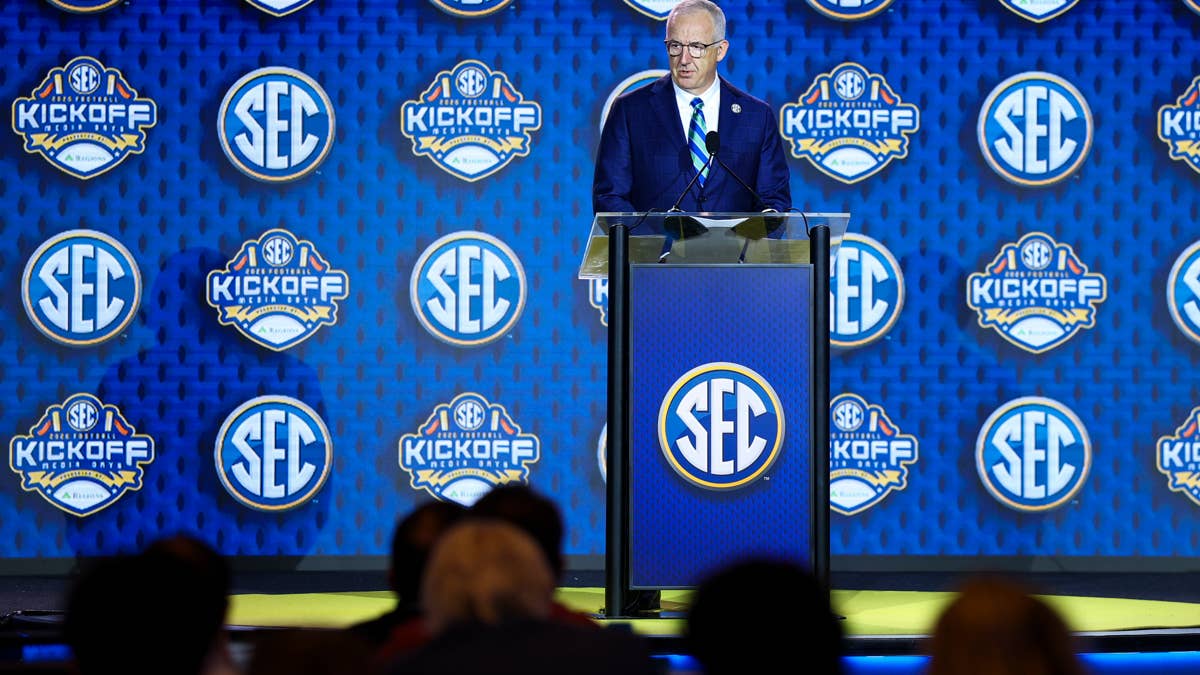
TAMPA, Fla. — SEC commissioner Greg Sankey began the conference's annual media days talking about success. He touted the SEC's talking points — increased viewership, additional scholarships, national championships — and said that success brings with it responsibility.
"One of our greatest responsibilities is to establish a stable national framework for college athletics," Sankey said.
Congressional intervention, at the behest of Sankey and other college sports leaders, is one of several issues hanging over the sport as the start of the 2026 season approaches. There seems to be agreement across conferences that the NCAA needs to be empowered to enforce its rules in an atmosphere that has been described as the Wild West more times than one can count. But there's disagreement among some major stakeholders over what Congress should allow or disallow.
"We have one opportunity to get this legislation right," Sankey said. "If Congress passes a bill and it's signed into law, we won't be returning to DC in a year or two asking and receiving help to correct the gaps that exist. That's why it's important that these commonsense areas be addressed now before the bill becomes law."
The stakes are high, so high that Sankey even addressed the concept of the SEC going solo, which was arguably the highlight of his Monday morning comments at the Tampa Marriott Water Street.
SEC Breakaway
Sankey was asked about conversations inside the SEC of the conference breaking away from the traditional college sports structure, and he did not shy away from that possibility.
"They're real," he said. "People have talked about that. They've opined about the frustrations that bring them to the point of saying we should look at something significantly different. I do not believe that is a leverage point. I think that's just honest communication."
Sankey said those comments are indicative of frustration with the current state of college sports.
"[The NCAA] must function in a healthy manner," Sankey said. "Otherwise, that simmering will continue."
© Nathan Ray Seebeck-Imagn Images
Call for Congressional Intervention
Sankey is among the college sports leaders who have called for the government to get involved in a sport that has struggled to govern itself.
"Congressional action remains a needed path to provide that long-term stability," Sankey said.
That action has heated up this summer with a bill in the Senate, sponsored by Sens. Ted Cruz (R-Texas) and Maria Cantwell (D-Washington). The proposed legislation would provide the NCAA with antitrust exemptions that would allow it to enforce its own rules regarding eligibility, transfers, NIL and revenue sharing.
"We support the effort behind the Protect College Sports Act," Sankey said. "However, we believe changes to the act are necessary to make it most effective."
Sankey said the SEC recommended 10 commonsense suggestions for the authors of the bill and emphasized that they are not SEC issues. "Those are changes that we believe benefit all of college athletics in providing a national solution," he said.
Those recommendations are based on four principles:
- National standards that can be enforced
- National framework that supersedes state laws
- Transparency and accountability
- Preservation of voluntary decision-making
"The changes we've suggested are most achievable and reasonable," Sankey said. "And we're committed to working with Congress to move the legislation across the finish line."
© Nathan Ray Seebeck-Imagn Images
College Football Playoff Expansion
Discourse about the future format of the College Football Playoff has ramped up in the last year, but such discussions date back further to its introduction in 2014.
That was when just four teams made the postseason field. Two years ago, that number tripled to 12. And now, there is talk of a 16- or 24-team format, though the CFP will stay at a dozen teams at least through the 2026 season.
The SEC is the lone Power 4 conference that has not thrown its support behind a 24-team field. And because the Big Ten and SEC are in charge of the future of the format, the CFP will not expand without the conference's support.
- Related: SEC Football 2026 All-Conference Team
Sankey preached the importance of preserving the value of the regular season if the postseason were to be expanded. And he said the SEC needs to gauge the interest from the associated media entities over the possibility of expansion.
Among the other sticking points Sankey mentioned were the interest of fans in expansion, conflicts with the academic calendar as the postseason stretches further into the spring semester and the well-being of the athletes before more games are tacked onto the schedule.
"When we went from four to 12, those questions were answered during the consideration process," Sankey said.
And then, of course, there's the conference championship game, a valuable entity — especially for the SEC — but one whose very existence seems to be at odds with length of the season and timing of the start of the postseason.
Future of Conference Championship Game
The SEC has gone at it alone with a conference championship before. Sankey was quick to point out that the SEC was the first to introduce the postseason game back in 1992. But it's hard to imagine a world in which the conference carries that torch alone if other leagues do away with their games.
- Related: SEC Football 2026 Predictions
Sankey said even the move to 12 put pressure on conference championship games, and discussion of further expansion threatens their continued existence. The SEC is still weighing the pros and cons. Unsurprisingly, Sankey said one of the deciding factors will be what happens with the CFP.
The 2026 SEC Championship is set for Dec. 5 at Mercedes-Benz Stadium in Atlanta.
"We have contracts and plans in place well beyond that," Sankey said. "But we have time for consideration."


