


Professional golf spends a lot of time arguing with itself. Some weeks, it feels like the sport’s biggest public conversation is about money, schedules, leagues, formats, contracts, television ratings and who may or may not be sitting in the same boardroom.
That noise matters, to a point. The professional game drives attention, creates stars and gives the rest of the golf world a stage. But if you step away from the weekly Tour conversation and look at golf from the ground level, where PGA Professionals, course operators, junior coaches, superintendents, parents, volunteers and everyday players live, the story is much better than the headlines often suggest.
Golf is not just surviving. Golf is growing.
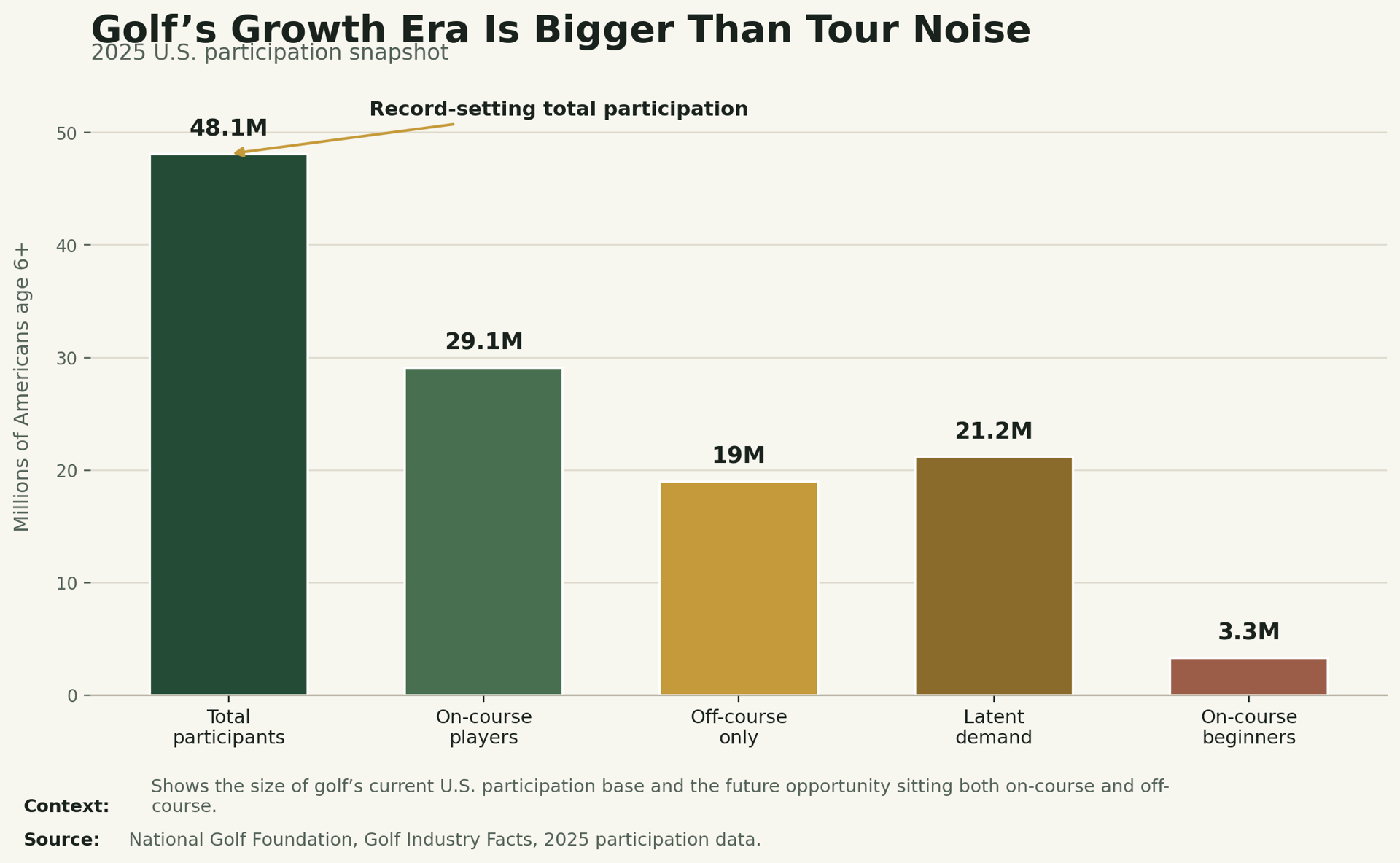
According to the latest industry data from the National Golf Foundation, 48.1 million Americans age 6 and older played golf in some form in 2025. That includes 29.1 million people who played on a golf course and another 19 million who participated exclusively in off-course golf activities such as driving ranges, simulators and golf entertainment venues.
That is not a small trend. That is a generational opportunity.
Industry Pulse
Golf’s Growth Era Is Bigger Than Tour Noise
While professional golf keeps arguing over structure, money and schedules, the actual game is showing real momentum at the ground level.
Total Reach
48.1M
Americans age 6+ participated in golf in 2025.
Green-Grass Game
29.1M
Played golf on a course.
Modern On-Ramp
19M
Participated exclusively off-course.
Newcomers
3.3M
On-course beginners in 2025.
Brendon’s read: The next challenge is not creating interest. It is converting curiosity into comfort and keeping new players connected long enough to become golfers for life.
Source: National Golf Foundation, Golf Industry Facts, 2025 participation data.
Golf’s Growth Story Is Bigger Than One Tour
The healthiest part of golf right now has very little to do with which player is leading a major, which Tour has momentum or which executive wins the next negotiation. The healthiest part of the game is that more people are finding golf in more ways, at more entry points, with less intimidation than many of us saw when we first came into the business.
As a PGA Professional who has spent three decades in this industry, I have seen golf from just about every angle. I have worked as a head professional, general manager, coach, teacher, educator, academy owner, nonprofit founder and writer. I have watched the game from behind the golf shop counter, on the lesson tee, inside career college classrooms, at junior golf events and through the eyes of parents trying to figure out whether this game has a place for their kids.
That is why these numbers matter. They are not just statistics on a page. They represent real people walking into golf for the first time, returning after years away or deciding that the game can fit into their lives in a way it may not have before.
The credit should be spread around. PGA Professionals have worked hard to make the game more welcoming. Facility operators have modernized programming, tee sheets and customer service. Superintendents have kept courses playable through historic demand. Junior golf leaders, women’s golf advocates, adaptive golf programs, nonprofits, brands and entertainment venues have all helped widen the front door.
For a game that used to spend too much time asking why people were not coming in, golf is finally doing a better job meeting people where they are.
Beginners Are Still Showing Up
One of the most encouraging pieces of the NGF snapshot is the beginner number. The organization reports 3.3 million on-course beginners in 2025, with annual newcomers at 3 million or more every year since 2020. Before the pandemic-era rise, annual newcomers had hovered around 2.5 million from 2016 to 2019.
That matters because golf’s biggest long-term challenge has never been simply getting people to try the game. It has been keeping them.
The first round of golf can be intimidating. The first range session can be confusing. The first trip to a real course can feel like learning a new language while also trying not to hold anyone up. That is where the industry’s next big test lives.
Growth is wonderful, but retention is the championship.
If someone starts at a simulator, Topgolf, a range, a short course or a beginner clinic, the job is not finished. The job is to help that person feel comfortable enough to take the next step. That means better instruction pathways, friendlier onboarding, more beginner leagues, clearer course expectations and fewer moments where new golfers feel like they are not welcome until they already know what they are doing.
The best teachers and operators understand this. The old model was often, “Figure it out, then come play.” The better model is, “Come as you are, and we will help you become a golfer.”
PGA Pro Takeaway
Growth Is Great. Retention Is the Championship.
Golf has done a better job opening the front door. The next win is helping new players feel comfortable enough to stay.
Step 1
Welcome
Make first-course experiences less intimidating and more clearly explained.
Step 2
Connect
Turn off-course curiosity into leagues, clinics, range-to-course programs and nine-hole play.
Step 3
Protect
Keep reasonably priced public golf available, relevant and properly supported.
Women and Girls Are Powering the Momentum
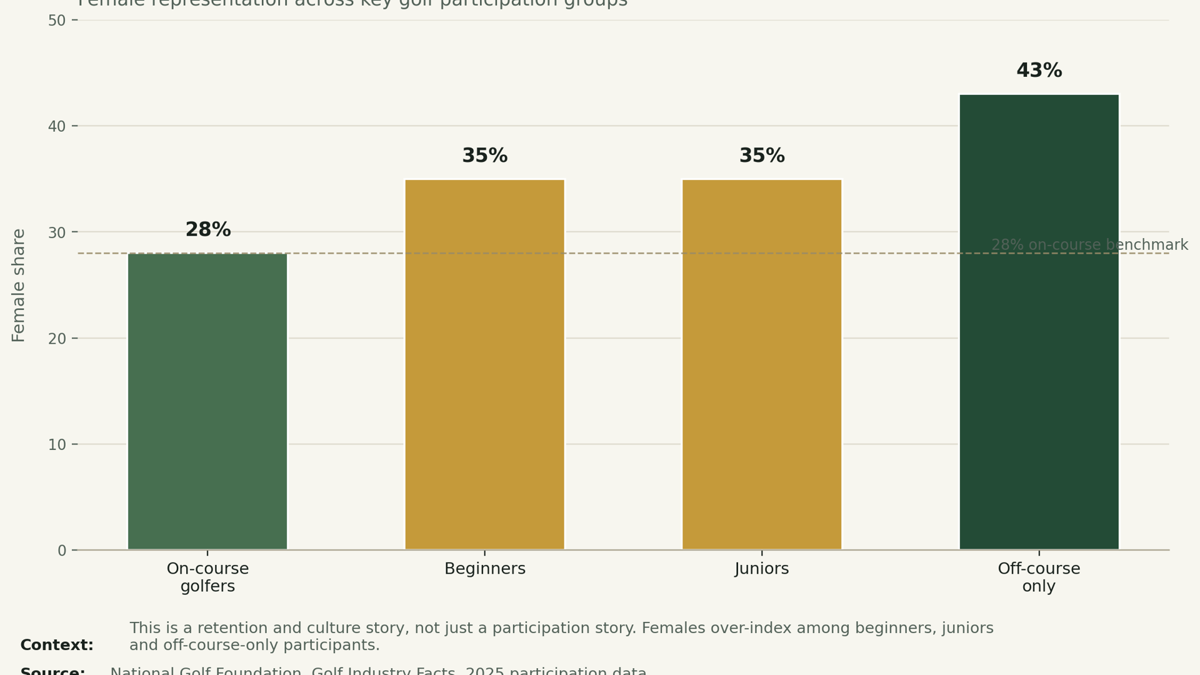
The rise in women’s and girls’ participation is one of the most important stories in the game. NGF reports more than 8 million female on-course golfers in 2025, with women representing 28% of on-course golfers, matching the highest proportion on record.
That is not just good news. That is structural progress.
Women and girls are also showing up strongly in the game’s most important growth categories. Females represent 35% of beginners, 35% of juniors and 43% of off-course-only participants. That tells us the future pipeline looks different, and better, than it did a generation ago.
Anyone who has coached juniors knows what that means at the facility level. It changes clinics. It changes leagues. It changes family participation. It changes the culture around the practice tee, the putting green and the first tee.
For years, golf talked about wanting to become more inclusive. Now the numbers show that the industry is making real progress. That progress did not happen by accident. It happened because countless people in the game, many of them far away from television cameras, built programs that made women, girls and families feel like golf belonged to them too.
Growth Segment
Women and Girls Are Changing Golf’s Future
Female participation is not just a feel-good industry note. It is a major driver in the game’s beginner, junior and off-course pipelines.
28%
Female share of on-course golfers.
35%
Female share of beginners.
35%
Girls’ share of junior golfers.
43%
Female share of off-course-only participants.
Why it matters: The facilities that make women, girls and families feel genuinely welcome will be the facilities best positioned to retain golf’s new energy.
Source: National Golf Foundation, Golf Industry Facts, 2025 participation data.
Off-Course Golf Is Not the Enemy
There was a time when some traditionalists looked at off-course golf as a threat. I never bought that. Anything that gets a club in someone’s hands, creates a positive first experience and removes some of the fear around the game should be viewed as an on-ramp.
The NGF data backs that up. Of the 48.1 million total U.S. golf participants in 2025, 19 million participated exclusively in off-course golf activities. That is a massive pool of future green-grass players if the industry handles the handoff correctly.
The key phrase is “if the industry handles the handoff correctly.”
A person who plays in a simulator league may not automatically book a Saturday morning tee time. A group that enjoys a golf entertainment venue may not immediately understand pace of play, course etiquette or what to do when they get to the first tee. That is not a failure by the consumer. That is an opportunity for the industry.
The best facilities will build bridges. Beginner-friendly nine-hole nights, social leagues, range-to-course programs, short-course experiences, family tees and low-pressure instruction can turn off-course curiosity into long-term golfers.
This is where PGA Professionals, coaches and facility leaders can shine. Technology may introduce people to golf, but people keep people in golf.
Public Access Remains the Pressure Point
Now for the part that deserves a careful, honest conversation: public access.
Golf can celebrate historic participation growth and still recognize that access is the piece that must remain under the microscope. According to NGF, roughly three-quarters of U.S. courses and facilities are open to public play, including about 2,600 municipal facilities and about 7,600 daily-fee facilities. That is the backbone of American golf.
Public golf is where most players enter the game. It is where families test the waters. It is where juniors get dropped off in the summer. It is where retirees play nine holes with friends, where high school teams practice, where beginners learn pace and etiquette and where many future lifelong golfers first fall in love with the sport.
NGF has also reported that approximately 70% of Core golfers had some of their earliest golf experiences at municipally owned or operated facilities. That stat should be taped to the wall in every meeting where communities debate the value of municipal golf.
The good news is that golf remains broadly accessible on paper. The more complicated reality is that access is not just about whether a course is technically open to the public. It is also about price, tee-time availability, location, transportation, junior access, beginner comfort and whether a player can reasonably make golf part of normal life.
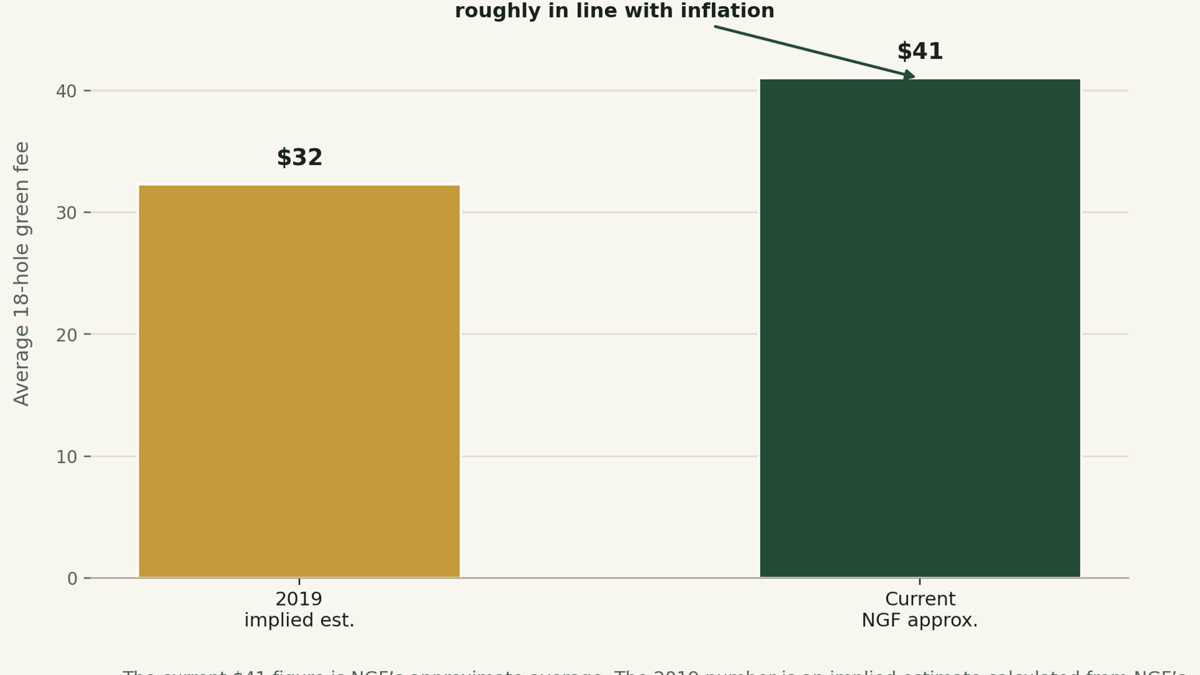
NGF reported the average 18-hole green fee for municipal and daily-fee courses is approximately $41, up 27% since 2019 and roughly in line with inflation. That context matters because it pushes back against the idea that all public golf has suddenly become unaffordable.
But perception matters too, and so does the weekend reality for many players. A $41 average does not mean every market feels affordable. In high-demand areas, especially near major population centers, tee times can be hard to find and prices can climb quickly. For the player trying to practice, walk nine after work, get a junior started or play a casual round without turning it into a major household expense, affordability is still very real.
That is the industry’s balancing act. Golf needs healthy facilities, and healthy facilities need revenue. But if reasonably priced public access disappears from too many communities, the growth story will eventually run into a wall.
The Pressure Point
Public Access Is Still Golf’s Front Door
Golf can celebrate historic growth and still be honest about the one issue that must remain protected: reasonably priced, welcoming public access.
~75%
Approximate share of U.S. courses and facilities open to public play.
Municipal
~2,600
Community-based facilities that remain one of the game’s most important development pipelines.
Daily Fee
~7,600
Public-access facilities that serve recreational golfers, families, juniors and regular weekly players.
!
The key distinction: Access is not only about whether a course is technically open to the public. It is about price, tee-time availability, beginner comfort, location, junior access and whether golf can fit into normal family life.
Source: National Golf Foundation, Golf Industry Facts, end-of-2025 facility data.
Municipal Golf Deserves More Respect
Municipal golf is often judged harshly because it lives in a public space, financially and politically. If a muni needs infrastructure investment, irrigation work, bunker renovation or clubhouse upgrades, it can become an easy target. The land is valuable. The balance sheet is scrutinized. The non-golfer asks why the city should care.
The answer is simple: because municipal golf is not just golf.
It is recreation. It is youth development. It is green space. It is community. It is a relatively affordable entry point into a game that teaches patience, accountability, resilience and social connection. It is also one of the few places where a 12-year-old, a 42-year-old beginner and a 78-year-old regular can all share the same property and feel like they belong.
NGF recently reported that municipally owned and operated golf courses have increased by 7% since 2006, while daily-fee public courses and private clubs have seen contraction over that longer period. That is a fascinating signal. Cities and counties are not just walking away from golf. In some cases, they are acquiring or preserving it.
That should be praised, but it should also come with responsibility. Municipal facilities cannot be treated as afterthoughts. They need thoughtful management, realistic capital planning, quality instruction, junior programming, women’s programming, beginner pathways and community buy-in.
A great muni can change a life. I know that because I have seen it happen.
Why Munis Matter
70%
Approximate share of Core golfers who had some of their earliest golf experiences at municipally owned or operated facilities.
Municipal Golf Does More Than Sell Tee Times
A strong muni is recreation, youth development, green space, community and golf’s most practical front door rolled into one.
Juniors
First clinics, camps, teams and summer memories.
Beginners
A lower-pressure place to learn the language of golf.
Communities
Affordable recreation and shared public space.
Source: National Golf Foundation, Inside Golf’s Foundational Municipal Renaissance.
The Industry Has Earned This Moment
Golf’s growth story deserves celebration. Not the kind where everyone takes a victory lap and assumes the work is done, but the kind where the industry acknowledges that years of programming, adaptation and outreach are producing meaningful results.
PGA Professionals deserve credit. So do LPGA Professionals, facility operators, superintendents, assistant professionals, junior coaches, school golf leaders, nonprofit organizers, adaptive golf advocates, women’s golf leaders, parents and the everyday golfers who invite someone new instead of keeping the game to themselves.
The game is healthier because more people have worked to make it healthier.
But the next chapter is important. Golf must protect the public-access pipeline. It must keep turning beginners into regulars. It must make sure off-course curiosity has a welcoming path to the golf course. It must continue investing in women, girls, juniors and diverse communities. It must recognize that affordability is not a talking point. It is a participation strategy.
Professional golf will keep arguing. That is part of the business now. But underneath all of that, the game itself is telling a much more encouraging story.
More people are playing. More people are interested. More people are finding golf on their own terms.
For anyone who has spent a lifetime believing in this game, that is not just interesting.
That is worth protecting.
PGA of America Golf Professional Brendon Elliott is an award-winning coach and golf writer who serves as Athlon Sports Senior Golf Writer. Read his recent “The Starter” on R.org, where he is their Lead Golf Writer. To stay updated on all of his latest work, sign up for his newsletter or visit his MuckRack Profile.


