


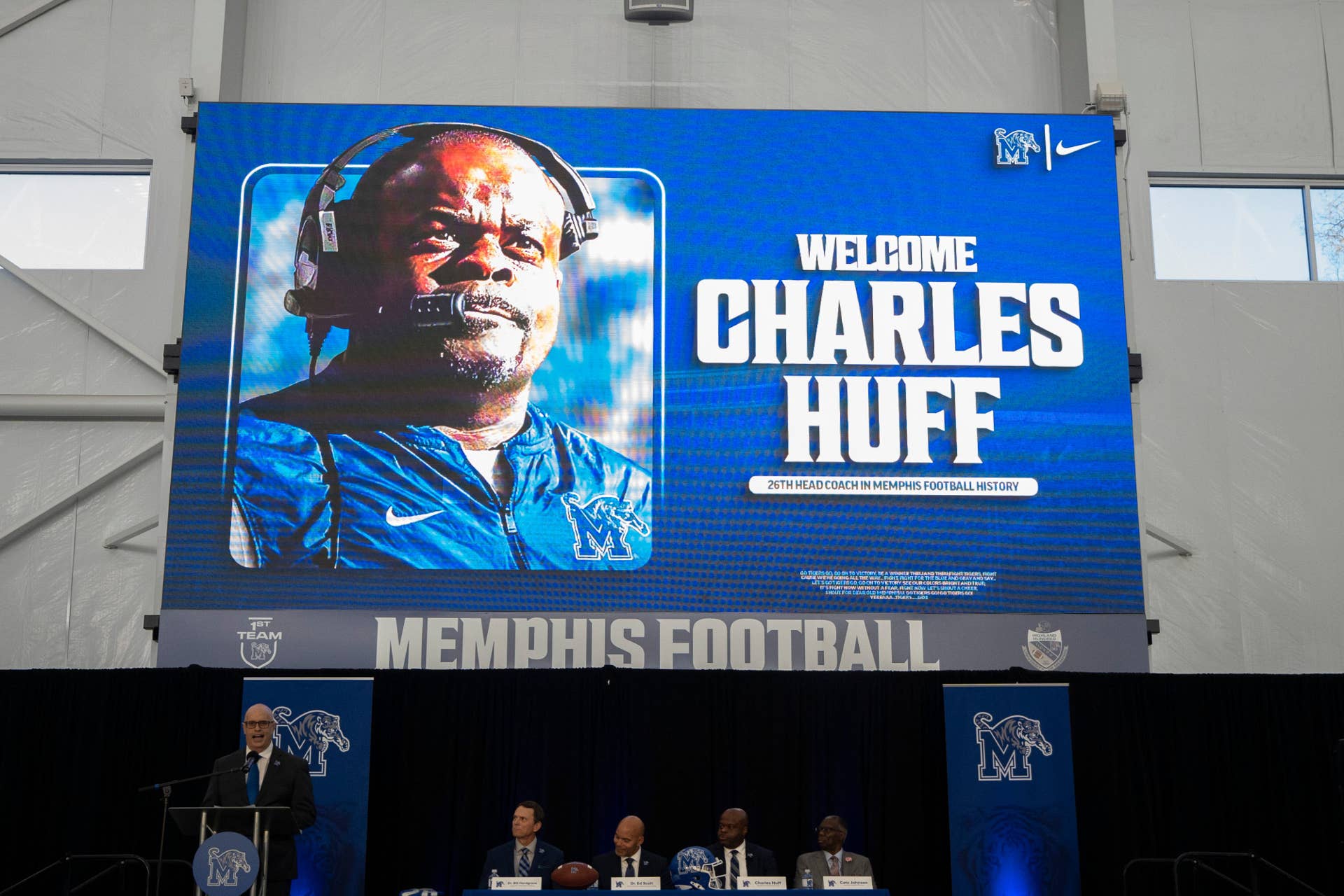
Being the new guy has to be getting old for Charles Huff. He was introduced as Memphis’ first-year head coach at American Conference media days last month, marking his third team in as many years.
If anyone can navigate that much change, it’s Huff, who has embraced an era of college football defined by player movement, coaching changes and conference reshuffling. He made his head coaching debut at Marshall in 2021, the year NIL was introduced, making him a coach of the moment.
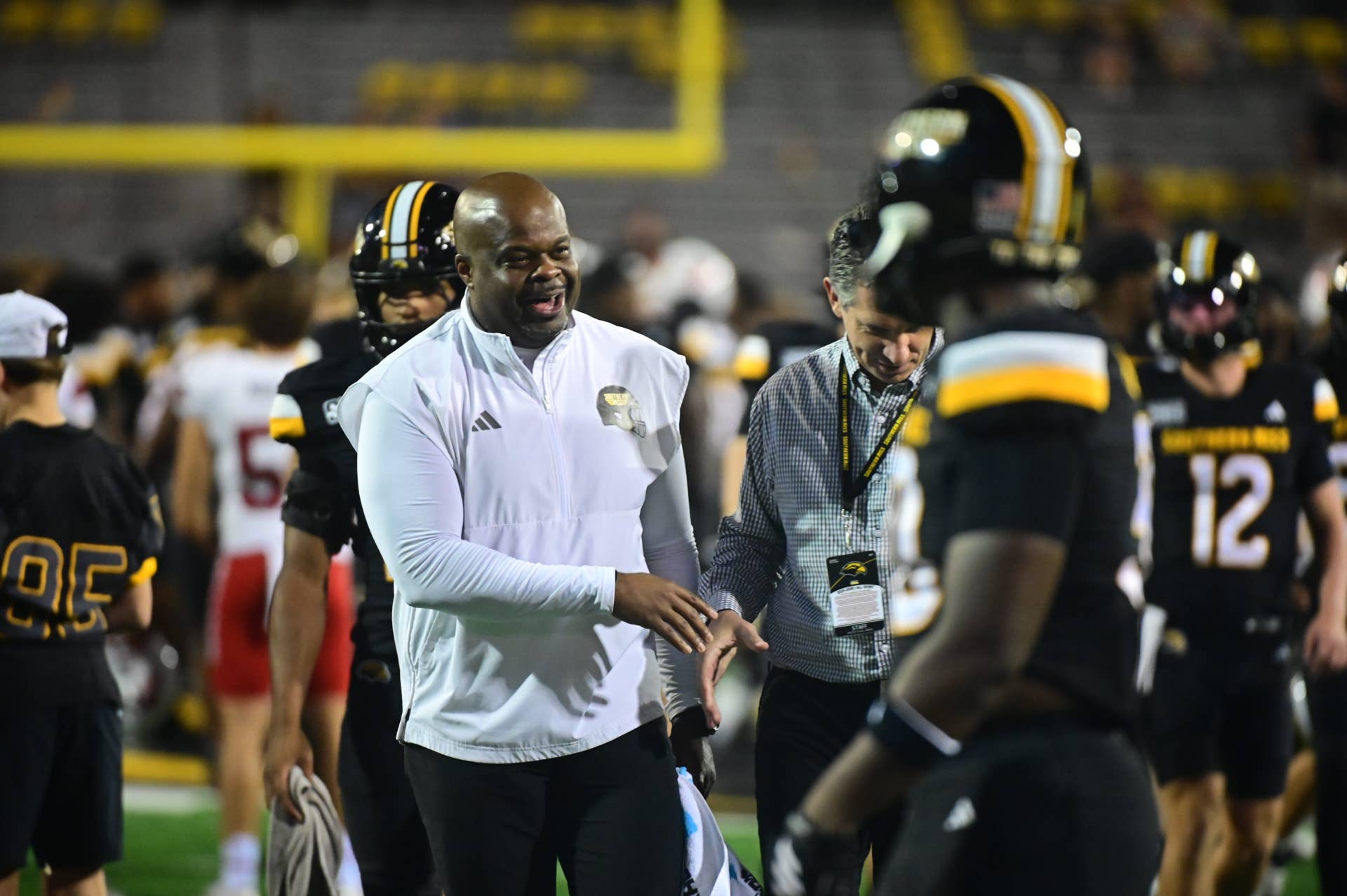
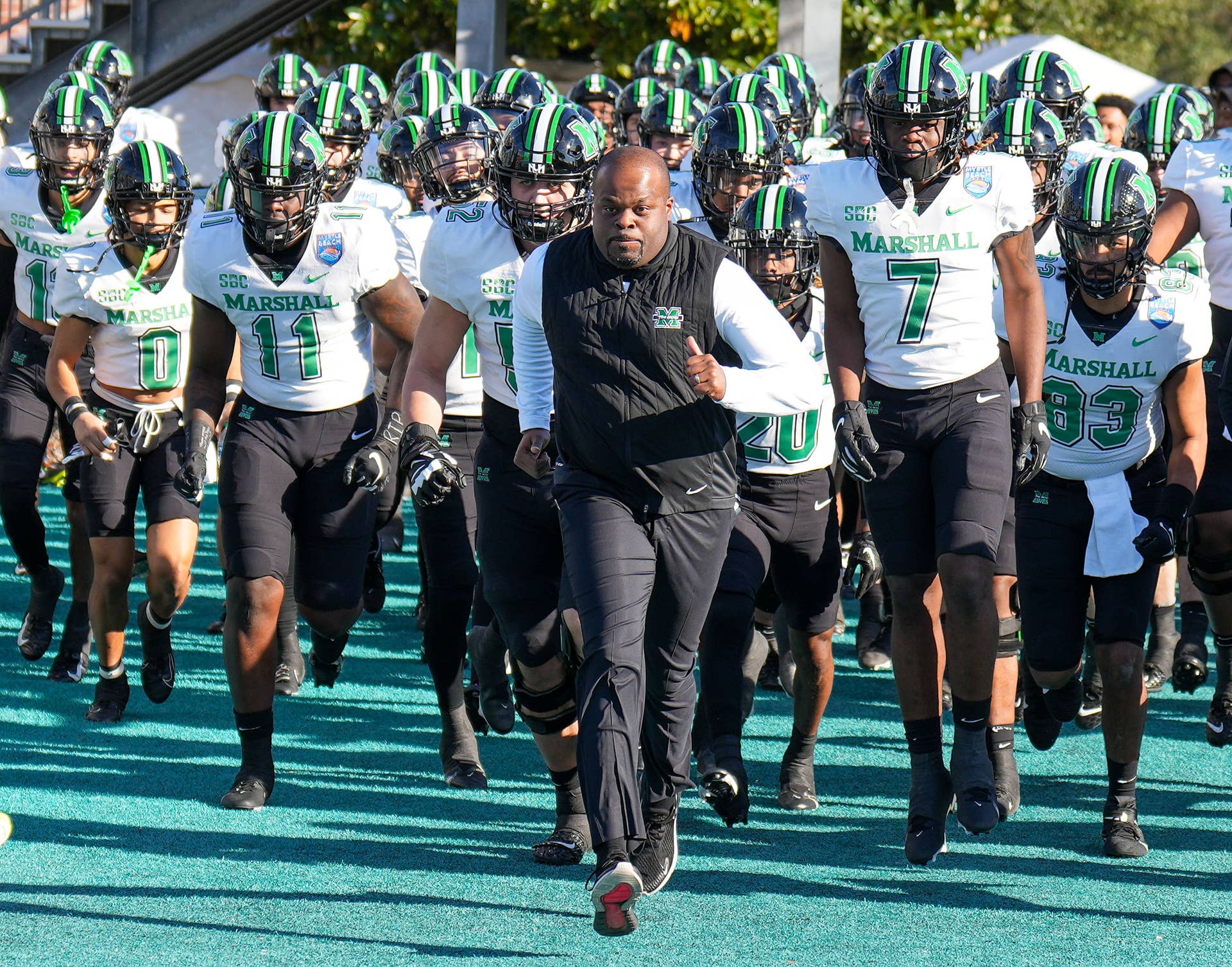
Marshall never missed a bowl game under Huff, who led the Thundering Herd to a conference championship. Then it took just one season for Huff to revive a struggling Southern Miss team. Success at those stops brought Huff to Memphis, a prominent Group of 6 program that has been a launching pad for its last three head coaches to SEC and ACC jobs.
The upcoming coaching carousel could see several openings at power conference programs. And if the Tigers are as good as expected this season, Huff will come up as a candidate.
Huff has been climbing for a while now — position coach, assistant head coach, head coach in the Sun Belt and now the American. The Power 4 would be the natural next step in this decades-long progression. But he isn’t necessarily pining for another change of scenery. He says he likes Memphis. And the Tigers are happy to have him at the helm — in part because Huff also has his own way of doing things, which could make him a perfect fit for the program’s aspirations.
Why not, he thought, bring the Power 4 to him?
“I’m in a vehicle that has the resources, that has the platform and has the opportunity to continue to grow,” Huff said at American Conference media days. “Hopefully, I’ll be staying here one more, two, or three more years, and then I’ll be standing in a Power 4 conference with the same logo on, with the same people, the same person, the same AD [athletic director], and, hopefully, some of the same players. Because I’m in a vehicle that can do that.”
© Chris Day/The Commercial Appeal / USA TODAY NETWORK via Imagn Images
It’s a nontraditional approach to a familiar dilemma at this level. Huff is hardly alone in his aspirations to join the Power 4, where the pay is higher, profile larger and prestige greater. A move to a power conference was broached at Memphis well before Huff was hired in December.
American Conference commissioner Tim Pernetti seemed to allude to those aspirations when he welcomed Huff onto the stage in St. Petersburg, Florida.
“I love that Memphis is continuing to think proactively, aggressively, innovatively,” Pernetti said. “And I think this hire is certainly no exception to that.”
People who play and work for Huff tend to stick with him or have a way of finding their way back to his side.
- Related: American Conference Fights for Retention Amid Extreme Turnover
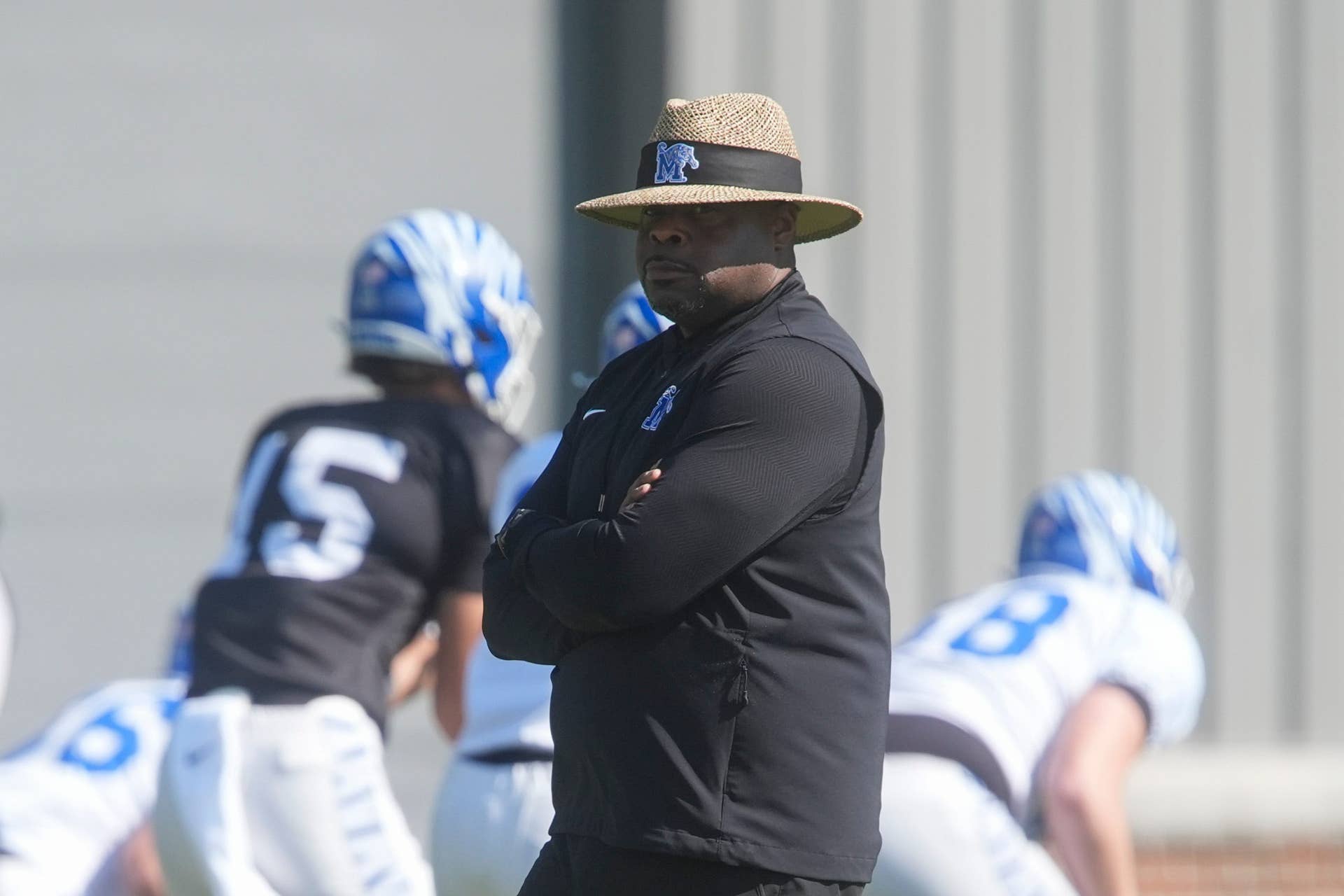
Memphis’ roster is primarily made up of transfers. Of the team’s 71 new players, 18 played for Huff at Southern Miss. Preseason all-conference safety Ian Foster is among that contingent, and he’s been with Huff since he was at Marshall.
Ben Ashford, the Tigers’ director of football athletic performance, has also been with Huff every step of the way. And Huff has reunited with defensive coordinator Lance Guidry, who called the defense in 2021 when the Thundering Herd upset Notre Dame.
“We’ve been blessed to be in a situation where we’ve been able to retain something even though we move locations,” Huff told Athlon Sports.
Offensive lineman Maarten Woudsma, a transfer from Old Dominion who played against Huff’s teams in the Sun Belt, said that level of loyalty told him all he needed to know about his new coach.
“If that number of guys can follow him and staff also, when I’m sure they’ve been offered other schools and positions, then I’m sure that I can trust him as well,” Woudsma said.
© Chris Day/The Commercial Appeal / USA TODAY NETWORK via Imagn Images
Linebacker Mike Montgomery, who transferred to Southern Miss last season and then made the move to Memphis, said not much is different from his time with the Golden Eagles. What noticeable changes there are result from playing in a program with more resources, like a dedicated director of football nutrition.
“It’s easy because nothing really changed,” Montgomery said. “Everything’s gotten better, but the core foundation and the core values have been the same. It was funny, coach Huff going viral for saying we don’t listen to music at practices. He ain’t been listening to music after practice ever since he’s been a head coach.
“Just because everybody can see it now, they think it’s hard or something like that. It’s been the same. Everything has been the same.”
In his opening address, Huff thanked the check writers and stakeholders who helped put Memphis in the position it is today — one where Huff discusses Power 4 aspirations as a matter of when rather than if. It’s not clear what it might take to earn an invite from a power conference after a dalliance with the Big 12 failed last summer. But it wouldn’t hurt to keep on winning.
- Related: Anonymous Coaches Weigh in on Top Group of 6 College Football Programs
The Tigers have the 14th-best record (88-41) in the FBS over the past decade. And they boast the third-best winning percentage in the Group of 6 behind only Boise State and James Madison.
“I’m standing on the shoulders of greatness,” Huff said. “Before I got here, there’s been a lot of success that has happened over the last three or four head coaches, which I’m honored to be standing on what they have built.”
Ryan Silverfield, Memphis’ last head coach, went 50-25 over six years before he left for Arkansas in December. Mike Norvell was 38-15 across four seasons with the Tigers before he departed for Florida State. And even Justin Fuente, who went 26-23 in four years at Memphis, parlayed that into the Virginia Tech job.
That success did well to raise the Tigers’ national profile. But Huff inherited just one returning starter from Silverfield’s last team and ample expectations to build on this recent run. That’s why, in his own words, Huff has become the “Lane Kiffin” of the Group of 6, the “portal king.”
Huff said he’s heard from plenty of players who transferred to his teams in their last year of eligibility that they wish they had played for him for all four years.
“And that means they didn’t find the connection or the transparency or the genuineness at their other stops,” Huff said.
- Related: American Conference Football 2026 Predictions
Those are among the reasons Huff said he believes players and coaches are willing to stick with him for multiple years and through multiple stops.
“I think because of my understanding and willingness to move for better opportunities, it helps me communicate better,” Huff said. “Because when a player walks in and says, ‘Hey, coach, P4 school X, wants me to come and they’re offering me triple what you’re offering me.’ I say ‘go.’ I don’t say, ‘You’re an idiot; don’t take the money; you’re not gonna play,’ all these things. Because if someone offered you triple your salary, you got to really think about it. It’s life changing.”
© Matt Bush/Special to the Clarion Ledger / USA TODAY NETWORK via Imagn Images
Huff views the portal as a tool. For coaches to round out a roster, yes, especially considering he’s taken 120-plus players out of the portal in the last two cycles. But it’s also a tool for players, in Huff’s eyes, to create value — whether it be money, development or playing time.
Regarding his outlook on the portal, Huff invokes a Sabanism: Adapt or die.
“A lot of coaches, when it first came out, this NIL and transfer portal, were so against it — it’s not going anywhere,” said Huff, who was on Nick Saban’s Alabama staff from 2019-20. “So you got to adapt. And I’ve been able to do that. I’m still adapting because it’s still changing.”
- Related: Anonymous Coaches Sound Off on Rivals’ NIL Spending, Financial Situation
Change seems to be the constant since Huff started coaching. The proliferation of the transfer portal and introduction of NIL and revenue sharing have enabled historic have-nots such as Indiana to win big.
Huff argues a success story like Curt Cignetti winning a national championship in his second season with the Hoosiers doesn’t put more pressure on coaches like him to win right away — that desire has always been there. Instead, the onus is on the fan base to invest resources up front to facilitate that return.
“You guys want Indiana?” Huff said. “OK, well we need Indiana support.”
It does not sound like Huff is wanting for much at Memphis, especially coming from Southern Miss and Marshall, where he got used to doing more with less. The Tigers’ $226 million renovation to Simmons Bank Stadium is on track for the home opener in Week 1.
© David Yeazell-Imagn Images
“We’ve got to be able to do more with more now,” Huff said. “Doesn’t make sense to get more and not get more results. So we’ve got to figure that out. We’re in a really good position. I think Memphis was set up to be successful.”
The Tigers haven’t had a losing record since 2013. Early projections peg them as a contender to win the American Conference and maybe even be in the mix for the College Football Playoff spot reserved for the highest-ranked team in the Group of 6.
- Related: Why Memphis Holds the Key to the Group of 6 College Football Playoff Race
Memphis opens at Mountain West favorite UNLV on Saturday. Two weeks later, the Tigers play at Pac-12 favorite Boise State. That’s before even getting into the conference slate, which includes trips to Tulane, South Florida and Navy.
That many marquee matchups could prove challenging. But the schedule also stands to bolster Memphis’ playoff case if it can win some of those tough games on the road. And a breakthrough season could spur the kind of upward movement Huff imagined for his new home.
“You just see the success that he’s had over the years and how successful he can be, he hasn’t even reached it,” Woudsma said of his coach. “There’s a higher tier to that.”
The Tigers will see just how high Huff can take them. Playoff? Power 4? After years of movement, it’s all in front of him at Memphis.


