


The NFL is full of recent quarterback redemption stories, from Geno Smith to Baker Mayfield to Sam Darnold. All kinds of quarterbacks who washed out with their first teams, found the right situation elsewhere, and made progress that few expected.
And for a while in 2025, Daniel Jones looked like the next in line to walk that path.
The primary reason for the Indianapolis Colts’ current playoff drought, which goes back to 2020, is that they’ve been living in the wilderness at the quarterback position since Andrew Luck’s surprise retirement on August 24, 2019. Philip Rivers, Carson Wentz, Matt Ryan, Gardner Minshew, Anthony Richardson, and Philip Rivers (again) were among the Luck replacements who couldn't quite get the job done.
The hope was that Jones, who the team signed to a one-year, $14 million contract before the 2025 season, could take the franchise out of said wilderness. Jones never panned out with the New York Giants, who selected him with the sixth overall pick in the 2019 draft.
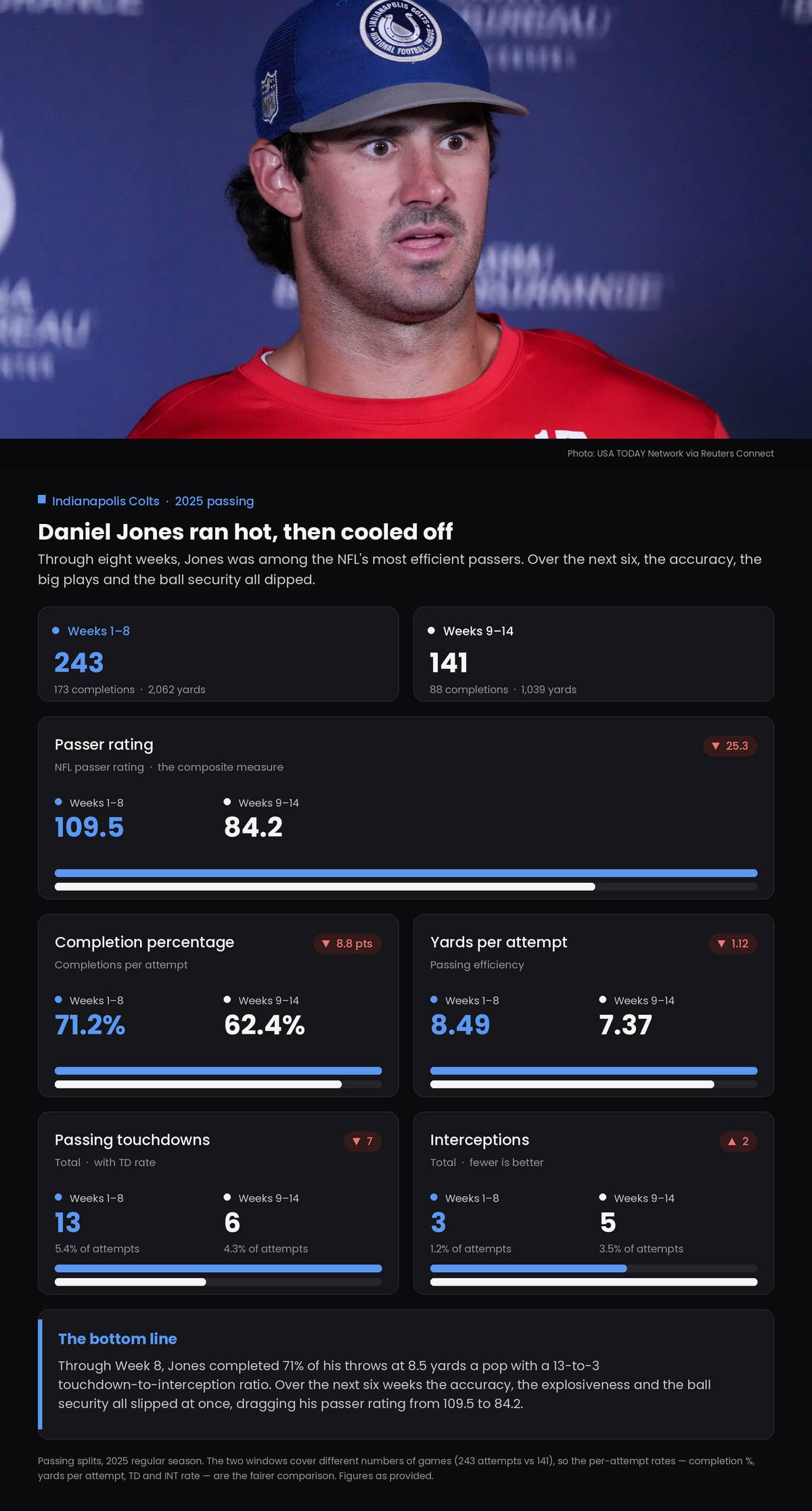
It worked very well for a while. In Weeks 1-8 under head coach and offensive shot-caller Shane Steichen, Jones completed 173 of 243 passes for 2,062 yards, 13 touchdowns, three interceptions, and a passer rating of 109.5. And at that point, Indy’s offense was as dangerous as any in the NFL.
Problem was, even before the season-ending torn Achilles tendon he suffered in Week 14 against the Jacksonville Jaguars, Jones had started to fall apart in familiar fashion. From Week 9 on, he completed 88 of 141 passes for 1,039 yards, six touchdowns, five interceptions, and a passer rating of 84.2.
Needless to say, the difference was alarming — and spoke to regression we'd seen from Jones before.
What happened? When Jones beat out Anthony Richardson in the preseason, head coach and offensive shot-caller Shane Steichen set his quarterback up well with pretty easy reads throughout the progression, especially his first read. No matter where Jones went with the ball, good things were to follow.
Then, things became more complex, and Jones struggled to respond. The timing was not what it had been before, and Jones put the ball in harm’s way more frequently. His three-interception game against the Pittsburgh Steelers in Week 9 was particularly disconcerting.
Jones also fumbled three times in the Colts' 27-20 loss to Pittsburgh, and he did the same against the Atlanta Falcons in a 31-25 overtime win. Per Next Gen Stats, the Falcons' defense blitzed Jones on over 40% of his dropbacks (46.2%), and he was sacked five times against the blitz against the Falcons — more sacks against the blitz than he had taken through Weeks 1-9 combined (three).
So, part of the problem may have been that the NFL simply figured Jones and the Colts out. Because of the injury, we still don't really know how Jones is able to react to that particular game of Spy vs. Spy, so 2026 will tell more of the story regarding Jones' professional rehabilitation.
And that's if Jones is fully recovered from the injury to take the field in Week 1 against the Baltimore Ravens.
“I mean, I think we did some good things early in the season, and were able to get into a rhythm there for a little bit, but we didn’t do enough, ultimately,” Jones said after the season ended. “And you look back at those games where it didn’t go as well as it could have, or you could have done a little bit more to finish it, especially there at the end. I think about the Houston [and] Kansas City games and some of those situations. But yeah, I think like I said, I’ve really enjoyed being here. I think it’s a really good team, good locker room and good coaching staff.”
The Colts signed Jones to a new two-year, $88 million contract this offseason with $44 million guaranteed, and the obvious hope now is that they’re getting the Daniel Jones they saw in the first half of the season, as opposed to the second.
Which is kind of the whole point for this franchise right now.


