


Cam Smith Has 97th-Percentile Bat Speed and a .218 Batting Average. One of Those Numbers Is Lying.
Cam Smith's Baseball Savant page is one of the more disorienting documents in fantasy baseball right now. It looks like two different players occupying the same entry.
On one side: 96th-percentile bat speed. 11th in MLB in max exit velocity. 31st in MLB in barrels. Outs above average of plus-5, which ranks 10th in all of baseball. A barrel rate that doubled year-over-year, from 6.9 percent to 11.9 percent. An average exit velocity that jumped from 211th in the league to 61st.
On the other side: a .218 batting average. A .294 wOBA. An 86 wRC+. A ground ball rate of 46.0 percent that is somehow worse than last year's 45.1 percent.
And then, buried in the pitch-type run value table, the thing that explains everything: a .087 xwOBA against the sweeper.
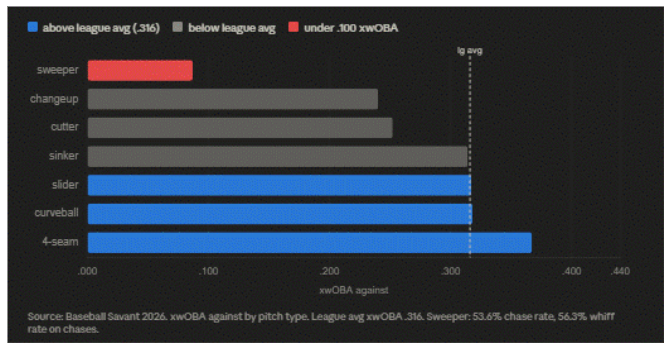
That number is not a typo. League average xwOBA is .316. Cam Smith, against sweepers, is producing an xwOBA of .087. He is chasing them 53.6 percent of the time and whiffing on 56.3 percent of those chases. At 145 pitches seen, that is a real sample. Pitchers have found the exploit. They are using it.
The Contact Quality Story Is Genuinely Good

© Scott Marshall-Imagn Images


Before getting to the bad news in full, the good news deserves its moment. The year-over-year contact quality improvement from Smith is real and it is significant. His barrel rate doubled. His hard-hit rate climbed from 40.8 percent to 44.6 percent. His xSLG jumped 67 points, from .376 to .443. His average exit velocity improved 1.5 mph and moved him from the bottom half of the league to the top quarter. His max exit velocity of 114.7 mph ranks 11th in all of baseball.
The contact quality distribution tells the same story. In 2025, 35.9 percent of his batted balls were topped — hit weakly on the ground with poor exit velocity. In 2026, that number has dropped to 32.2 percent. Barrels are up, topped balls are down, and the hard-hit rate confirms the bat is generating better contact events.
The problem is that the ground ball rate has not moved. It was 45.1 percent in 2025. It is 46.0 percent in 2026. Smith is hitting the ball harder than ever and still hitting it into the ground at the same rate. The stance adjustment the Astros made — moving him 6.6 inches back in the box, shifting from open to slightly closed — improved the quality of contact without yet changing where that contact is going.
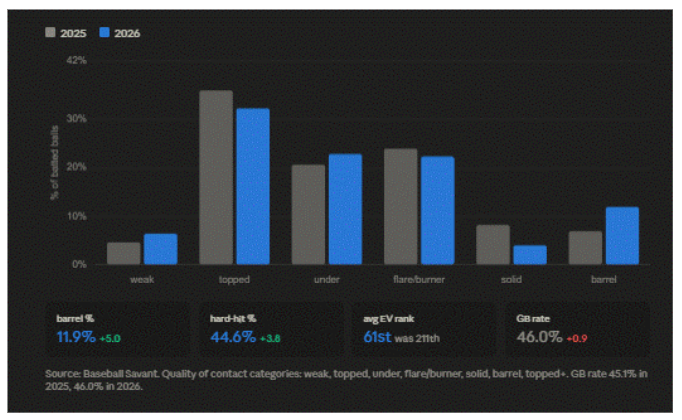
His xwOBA of .332 confirms the gap. His actual wOBA is .294. Those 38 points are entirely explained by a hitter who is generating legitimately above-average contact quality and routing roughly half of it into the ground.
The Sweeper Is the Real Problem

The pitch-type data is where the Savant page gets genuinely alarming. Smith handles four-seamers fine — .367 xwOBA, above league average. He handles curveballs fine. He handles sliders near league average. Against fastballs broadly, he is a functional major league hitter.
Then the sweeper. The wide, horizontal-breaking pitch that is currently accounting for 11.2 percent of pitches he sees is generating a .087 xwOBA. For context: a .087 xwOBA is roughly the output of a hitter who never makes meaningful contact. The chase rate against it is 53.6 percent. The whiff rate on those chases is 56.3 percent. He is not just struggling against sweepers — he is among the most exploitable hitters in baseball against them right now.
This matters for the second half in a specific way: as opposing pitching staffs update their scouting reports, the sweeper share of pitches Smith sees will increase. It already represents more than one in nine pitches. By August it could be one in six. If Smith does not make an adjustment to that pitch specifically, the ground ball rate and the surface results will not improve regardless of what the barrel rate does.
What You Are Actually Buying
Smith is 23 years old, has played fewer than 40 minor league games, and is 31st in the majors in barrels. His sprint speed of 29.3 feet per second ranks 31st in MLB and has translated to eight stolen bases despite regular platoon restrictions against lefties. His .218 batting average is available in most leagues right now.
If the launch angle corrects and the ground ball rate drops below 42 percent, Smith's contact quality profile projects to 18 to 22 home runs and 15 to 20 stolen bases over a full season — a legitimate top-25 outfielder. His xSLG of .443 and barrel rate of 11.9 percent both support that ceiling.
If the sweeper adjustment does not happen, the ceiling compresses. A hitter with a known exploitable weakness and a 46 percent ground ball rate produces a useful stolen base contributor with volatile power — worth owning in deeper formats, a streaming option in shallower ones.
The two things to watch going forward are now specific and trackable. First: his rolling ground ball rate on FanGraphs, updated daily. Second: his xwOBA against sweepers on the Savant pitch-type splits page. If the ground ball rate starts moving toward 42 percent and the sweeper xwOBA climbs above .200, the contact quality that ranks him 31st in barrels will start showing up in the box score. Until then, you own the potential.
The bat speed is 96th percentile. The Savant page confirms it. The Savant page also explains exactly why it has not mattered yet. Both things are true at the same time, and one of them is going to win.
Questions About Cam Smith, Answered
Should I add Cam Smith in fantasy baseball right now?
Yes, if he is available. Smith's underlying contact quality remains strong despite his surface production. His improved barrel rate, hard-hit rate, and expected metrics indicate better results than his batting average and wRC+ currently reflect, making him a worthwhile addition if available.
Why is Cam Smith's wRC+ so low despite elite bat speed?
His elite bat speed has been offset by a high ground ball rate and an extreme weakness against sweepers. Those factors have prevented his improved contact quality from consistently translating into productive offensive results.
What is Cam Smith's 2026 Statcast profile?
Smith has improved his barrel rate, hard-hit rate, average exit velocity, and expected slugging percentage compared to last season. His contact quality has improved significantly even though his traditional production has lagged behind.
What is Cam Smith's stolen base upside in fantasy baseball?
His elite sprint speed gives him legitimate stolen base value. If he continues to receive regular playing time, he has the athleticism to contribute meaningful totals on the bases alongside his power upside.
What is Cam Smith's second-half outlook in fantasy baseball?
His outlook depends on whether he reduces his ground ball rate and improves against sweepers. If those adjustments occur, his improved contact quality could translate into a substantial second-half breakout.
Is Cam Smith a buy or sell in fantasy baseball right now?
Buy. The underlying skills remain stronger than the surface statistics, making the current slump a potential buying opportunity if the necessary adjustments begin to take hold.


