


A quick skim of college football scores a few weeks into the season induced a double take.
Okay, Duke outlasted Illinois. Wow, North Texas upset UNLV. Wait, how many points did James Madison beat Wagner by?
For those who didn’t tune into ESPN+ on Sept. 12 for JMU’s evisceration of the Seahawks, an FCS program in Staten Island, the Dukes won 87-3. That’s not a football score. That’s more like the score of a high school basketball game that got out of hand and made it onto SportsCenter.
James Madison’s 84-point win set a new program record. It was also the largest margin of victory in a game involving an FBS program since 2012, when Oklahoma State beat FCS Savannah State 84-0. But the Dukes’ outburst wasn’t even the first time a team scored 80 points this season. And it wasn’t the last.
Anecdotally, it felt like abnormally large blowouts were occurring at an above average rate. Statistically, it turns out that is the case. An Athlon Sports analysis found that over the past 10 years, only two teams have scored more than 80 points in a single game. This year, just three weeks into the season, three teams have put up 80-plus points — two of which won by more than 80 points. The current campaign has also already seen more 70-point margins of victory than any single season in the last decade.
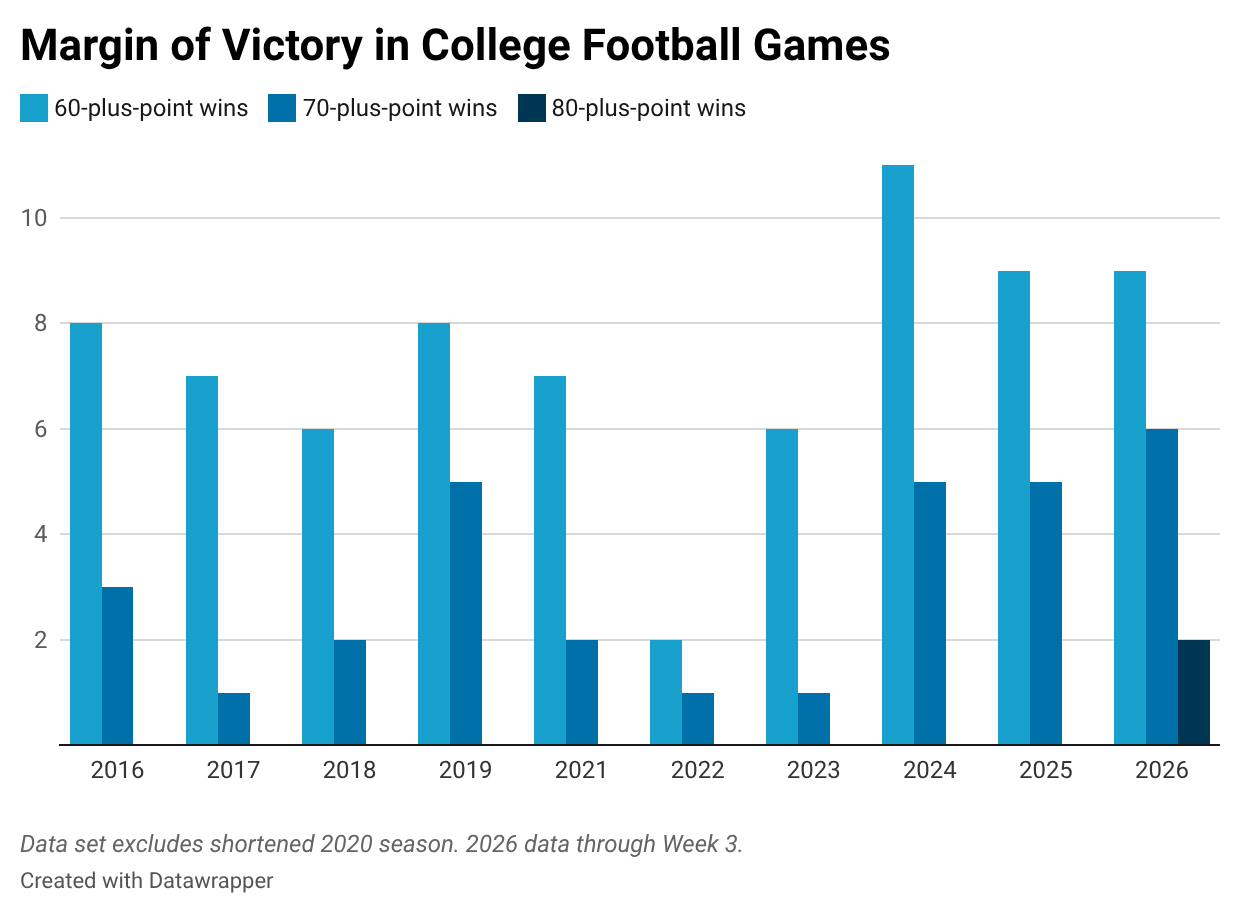
James Madison’s landslide victory was matched six days later when then-No. 20 Oregon beat FCS Portland State 84-0 on Sept. 18.
Oklahoma State’s 2012 win against Savannah State had stood alone as the only 80-point margin for years. And now, within the span of a week, two teams had matched that margin. What, exactly, is happening here?
I reached out to ESPN’s Bill Connelly — a self-professed “professional nerd” who ranks all 772 teams that play college football — to figure out what was behind the spike.
“Separation between power conferences and G6 [Group of 6] has gotten a little bigger, and separation between FBS and FCS has gotten a little bigger just because of the flow of talent upward,” Connelly said, referencing the prevalence of the transfer portal.
He used to use 28 points as the adjustment when projecting the outcomes of FCS vs. FBS games in his SP+ model. But after the 2025 season, he bumped that up to 33 points to account for the greater disparity in talent.
“So now when you play a lower-level FCS team, instead of on average beating them by 50 or whatever, you’d be beating them by 55,” Connelly said.
- Related: Tarleton State Keeps Beating FBS Teams. Will Texans Be Next to Transition?
Note that he said lower level. There have already been six FCS-over-FBS upsets this season. But the Power 4 programs that are scheduling FCS opponents aren’t taking the chance against teams like Montana State, Tarleton State or Illinois State, all of which beat a Group of 6 team in 2026. Instead, they’re scheduling teams further down the rankings, which leads to some of these bloated scores.
“The top FCS schools are doing just fine,” Connelly said. “It’s just nobody’s scheduling those teams.”

Craig Strobeck-Imagn Images
An unlikely team joined James Madison and Oregon in scoring 80 points in a single game. The Dukes and Ducks both made the College Football Playoff a season ago and have realistic aspirations of a return trip. But Louisiana Tech is a middle-of-the-pack Sun Belt team that began its season with an 80-6 romp of Northwestern State, an FCS program with one win since 2023.
There are only two other instances of teams scoring 80 since 2016, and they involve some of the aforementioned teams. Oregon also beat Portland State 81-7 in 2023. And in 2024, South Alabama beat Northwestern State 87-10.
There has also been a noticeable uptick in teams scoring — and winning by — 70 points. Twelve teams have cracked that threshold this season, and half of those games were decided by at least 70 points.
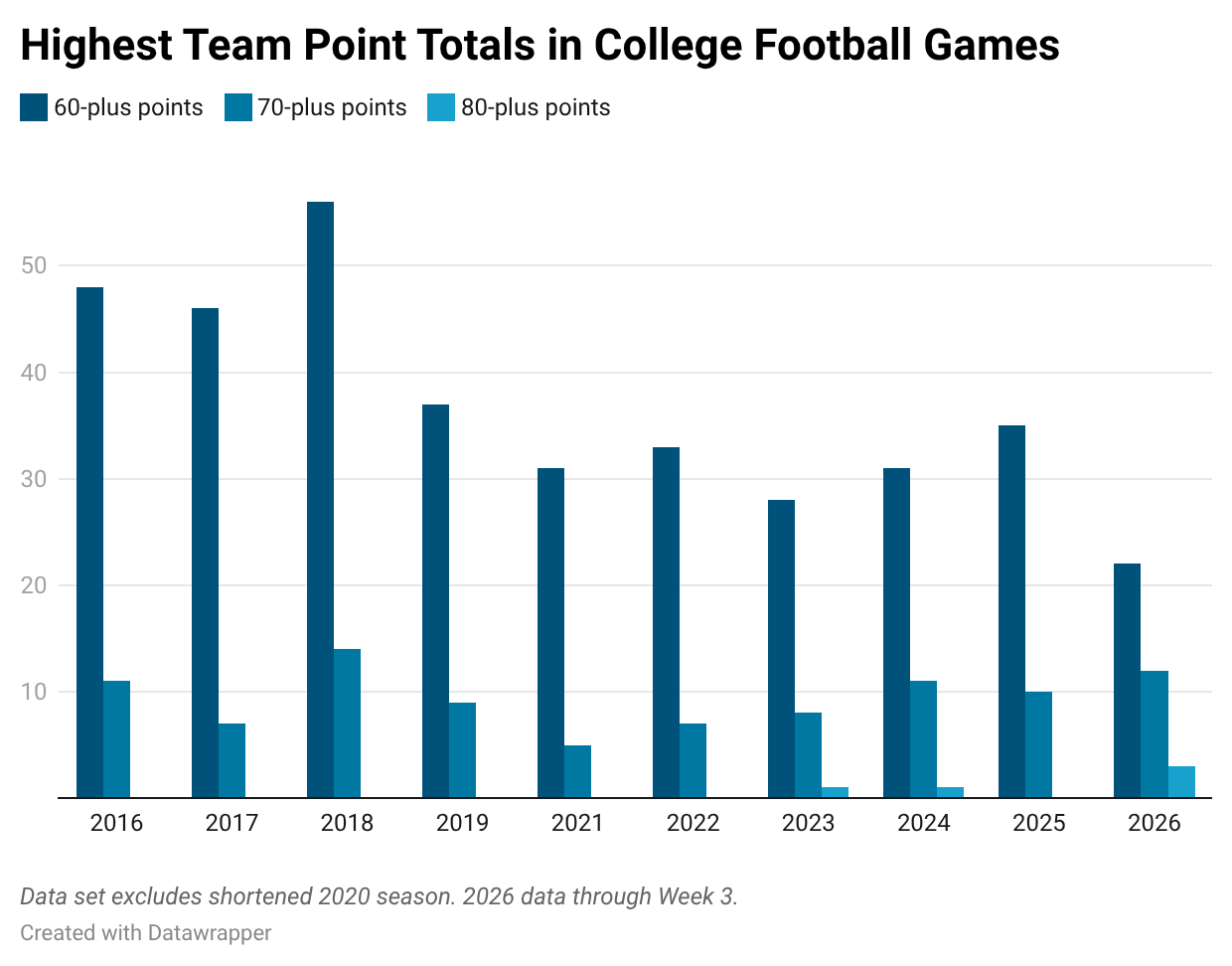
Some of those contests involved top-tier teams against lower-level competition, like then-No. 7 Miami beating Florida A&M 77-7. Then-No. 22 Houston also beat Southern 77-6. There’s also the case of a team like NC State, which has not won a game other than a 73-0 victory over Richmond.
“There are a lot of people who kind of want the power conferences to break away, and so every time that one of these games happens, they use that as a way to say, ‘See, the separation’s too big, and we’re just gonna have to do this,'” Connelly said, alluding to the long-rumored split. “And so they try to use it to their benefit in that regard. In a vacuum, it doesn’t mean anything, because it’s what the power conference teams are choosing.”
© Sam Navarro-Imagn Images
The only 70-point game involving two FBS teams was No. 2 Georgia’s 70-20 victory over Western Kentucky. So far, that result does not seem like much of an outlier considering the Bulldogs lead the FBS in scoring average at 59.3 points per game.
Connelly maintains there’s little incentive in running up the score for anyone who believes the College Football Playoff committee will look more kindly on Oregon’s 84-point win as opposed to what his model projected as a 72-point victory.
“I don’t think running up the score really benefits you in any way,” he said, “and I don’t think teams are really trying to.”
This season already stands out in recent college football history for the frequency of these lopsided margins and high totals. And there could be more on the way with more FCS vs. FBS games still to be played. Connelly mentions Bucknell-Pitt, McNeese-LSU and Samford-Auburn as games that could potentially join the list.
Scoring — or winning by — 90 is naturally the next step in the ascent toward more uneven games. But what about the century mark? It’s only been done once in a game between two FBS teams. Houston beat Tulsa 100-6 in 1968.
“I could see it, but it’s gonna be hard, ’cause I think everybody — that seems to be where people are drawing the line,” Connelly said, referencing Division II Grand Valley State’s recent 96-0 win over NAIA Judson. “‘Okay, we can’t do that, but we’re gonna get as close to that as we can.'”


